Once you have decided you want a privacy screen protector, the next question is where to buy one — and the channel you choose matters more than you might expect. Privacy protectors vary enormously in quality, the market is full of vague listings and exaggerated claims, and where you shop determines whether you get a properly fitted, well-made protector or a dim, murky disappointment.
This guide walks through your four main options — online marketplaces, carrier stores, electronics retailers, and brand stores — comparing what each offers on price, fitting help, and quality, plus the checks to run before you hand over any money.
Key Takeaways
- Online marketplaces offer the widest choice and lowest prices, but quality variance is the highest.
- Carrier stores are convenient and often fit the protector for you, at premium prices.
- Electronics retailers balance price and reliability, with staff advice and easy returns.
- Brand stores (like Apple Stores) stock curated, guaranteed-fit protectors — the safest but priciest route.
- Wherever you buy, verify the protector is cut for your exact model and check the return policy first.
Online Marketplaces and Retailers
Large online marketplaces are where most privacy protectors are sold, and the advantages are real: a vast selection for every phone model including older and obscure ones, competitive prices driven by thousands of sellers, and delivery to your door. If you know your exact model and are comfortable fitting the protector yourself, online is the value option.
The catch is quality variance. Privacy protectors are the easiest accessory to fake on a listing: a cheap, dim glass with a crude tint sits behind the same stock photos as a premium one, and “privacy” claims are rarely verifiable until the thing is on your phone. Counter this by favouring established accessory brands’ official stores within the marketplace, reading reviews that specifically mention brightness and viewing angles, and treating any listing without a clear model-specific size chart as a warning sign. Direct-from-brand websites are the online gold standard: slightly pricier than marketplace chaos, but with a named warranty and support behind the product.
- On marketplaces, sort by review count within your exact phone model, not by overall rating. A privacy protector that works beautifully on one phone can have a sensor cutout problem on another — model-specific reviews reveal fit issues that generic five-star averages hide.
Carrier Stores
Your mobile network’s shops (the carrier stores on the high street) stock protectors for the phones they sell, and their big selling point is convenience plus fitting. Buy a phone or visit with one, and staff will usually apply the protector for you on the spot — a genuinely valuable service if your previous self-installations have ended in bubbles. You also get certainty that the protector matches the phone in your hand, because they check it against the device.
The trade-offs: carrier stores charge close to full retail price, sometimes notably more than the same brand costs online, and the range is narrow — typically one or two options per model, take it or leave it. The staff are helpful but are sales staff first; a carrier-branded privacy protector may be a rebadged budget product at a premium price. It is a fair choice when you value the free fitting and immediacy over the last few pounds.
Electronics Retailers
Big electronics chains and department stores sit in the sensible middle. They carry recognised accessory brands rather than anonymous imports, prices land between marketplace lows and carrier highs, and — crucially — they have proper returns counters. If the privacy effect turns out too dim for your taste, walking back in with a receipt is a very different experience from arguing with a marketplace seller overseas.
Staff knowledge varies but is generally better than average, and many stores will fit the protector at the till or have a fitting service for a small fee. The one weakness is range for older models: chains stock for current and recent phones, so if your device is three or four generations old, you will likely be pushed back online anyway.
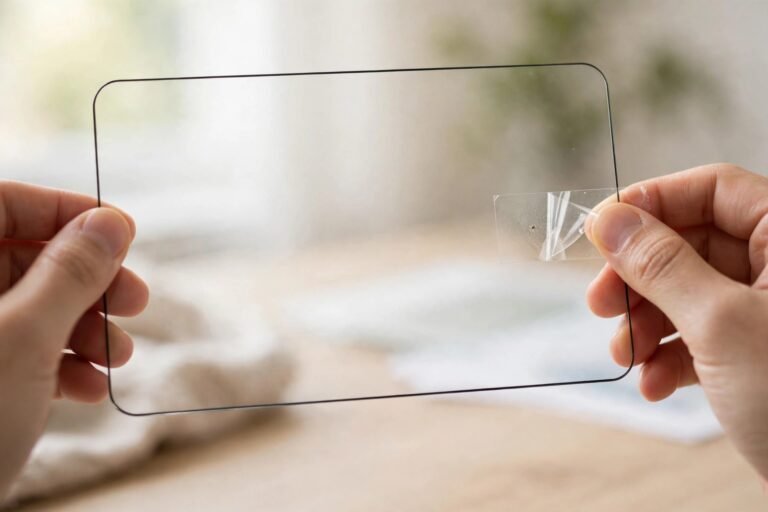
- Whichever shop you use, dry-fit before you commit: hold the protector over your screen without peeling the backing, and check the cutouts against your camera and sensors. Shops with a returns desk will usually let you exchange an unfitted wrong-size protector without fuss.
Brand Stores and Authorised Retailers
Buying from the phone manufacturer’s own store — an Apple Store, a Samsung Experience Store, or their online equivalents — is the lowest-risk option of all. The protectors stocked are curated for the current models, fit is guaranteed, and several manufacturer stores offer machine-aligned professional fitting, which is about as close to a perfect installation as a human process gets. If you have just spent flagship money on a phone and want zero drama, this is where to go.
Predictably, it is also the most expensive route, and the choice is limited to the one or two brands the manufacturer partners with. You are paying a premium for certainty and service rather than for a fundamentally better piece of glass — the same protector often exists online for less, minus the fitting and the guarantee. Know what you are paying for, and it can be worth it.
What to Check Before You Buy, Anywhere
A few checks apply in every channel. First, exact model match: your phone’s precise model and generation, confirmed in its settings if you are unsure — “fits most 6.1-inch phones” is not a size. Second, privacy angle: quality protectors state a viewing angle (commonly around 28–30 degrees); a listing that never mentions one is hiding something. Third, case compatibility if you use a case — look for “case-friendly” in the description. Fourth, the returns policy for opened protectors, because a privacy protector’s dimming effect can only be judged once fitted, and channels differ wildly in whether they will take one back.
Frequently Asked Questions
Are cheap online privacy protectors worth it?
Sometimes — budget protectors from established brands are often fine. The risk is with no-name listings: poor louvre quality means a screen that is murky even head-on. If the price seems too good for a privacy product, the privacy layer is usually where the saving was made.
Will a store fit a protector I bought elsewhere?
Some electronics retailers and repair kiosks will fit a protector for a small fee regardless of where you bought it; carrier and brand stores usually only fit their own stock. Ask before you go — it can combine online prices with professional fitting.
How do I avoid fake or mislabelled privacy protectors?
Buy from the brand’s official storefront or an authorised retailer, check that the listing names your exact model, and read recent reviews mentioning the privacy effect specifically. On arrival, test the viewing angle before fully committing — a real privacy protector blacks out clearly from the side.
Buy online for price and choice, in person for fitting and peace of mind — and in every channel, check the exact model, the privacy angle, and the returns policy before the till.