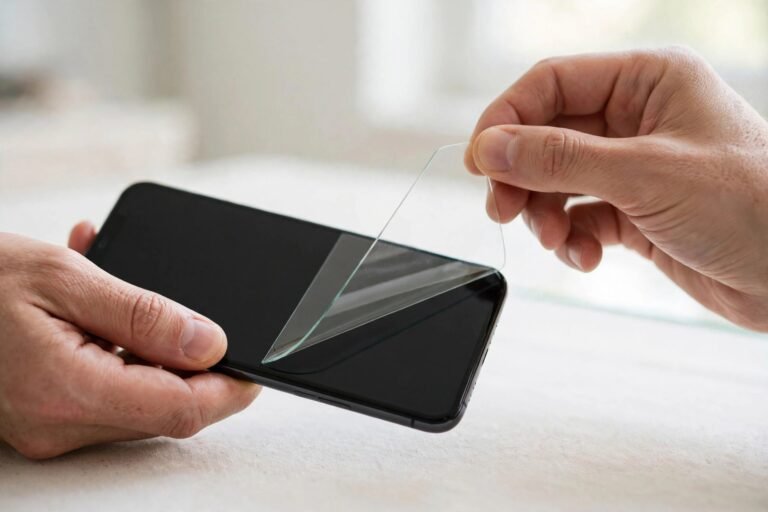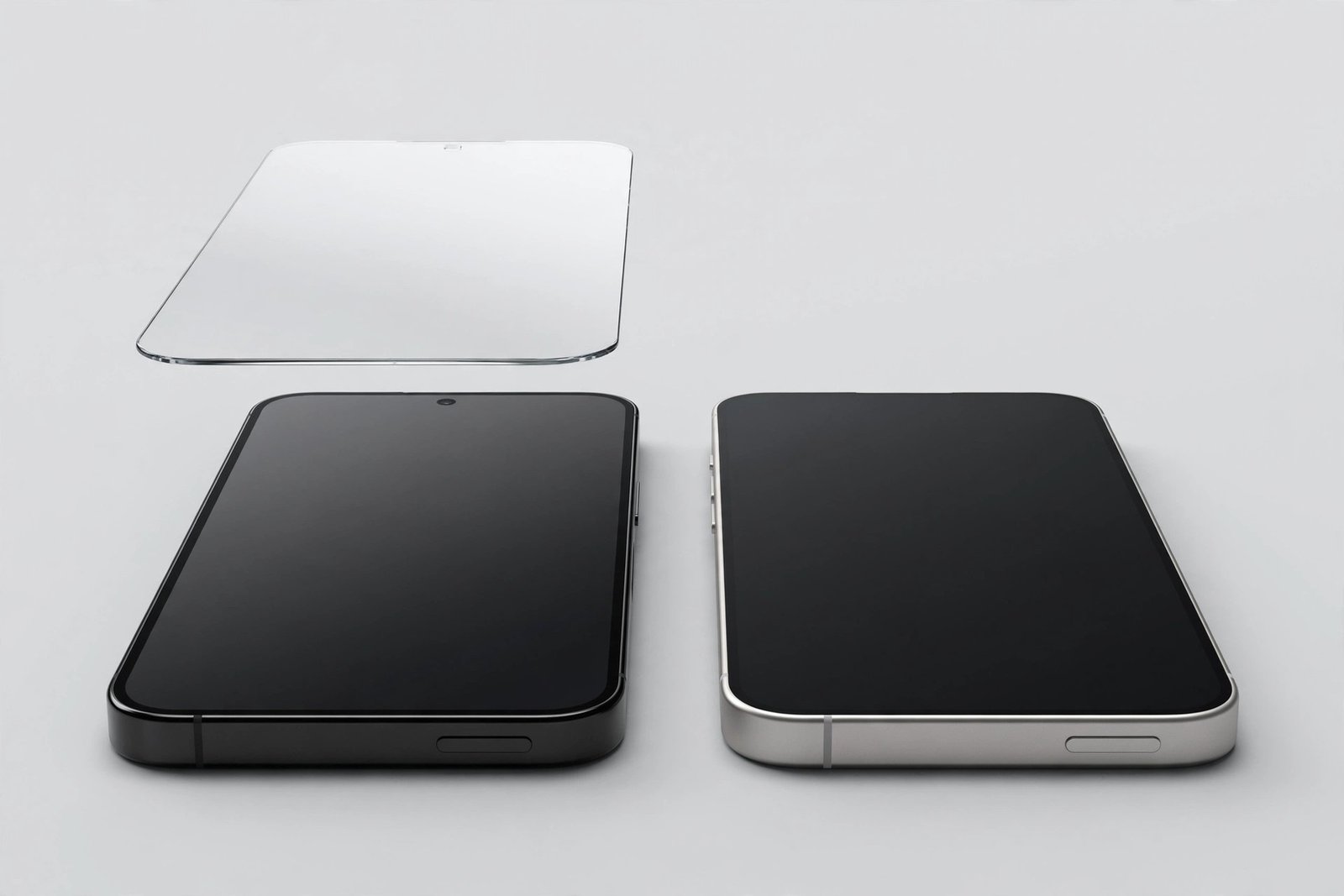
On paper, this pairing looks like it should work. The iPhone 13 Pro Max and iPhone 14 Pro Max both have 6.7-inch displays, both are big slab-sided phones, and their screen protectors even look similar laid side by side. If you have a spare 14 Pro Max protector in a drawer — or found one cheaper than the 13 Pro Max version — it is tempting to ask whether it will simply fit.
The honest answer is no — not properly. The two phones differ in the two places a screen protector cares about most: the shape of the cut-out at the top of the display, and the phone’s exact physical dimensions. This guide explains those differences, what actually happens if you try the swap anyway, and why a model-specific protector is always the right buy here.
Key Takeaways
- Both phones have 6.7-inch displays, but screen size alone does not determine protector fit.
- The 13 Pro Max has a notch; the 14 Pro Max has the Dynamic Island — their top cut-outs are completely different shapes in different positions.
- The 14 Pro Max is slightly narrower and thicker than the 13 Pro Max, so its protector is cut to different overall dimensions.
- A cross-fitted protector will misalign, risk covering sensors, and lift at the edges — buy the protector made for your model.
- The same rule runs in reverse: a 13 Pro Max protector does not fit a 14 Pro Max either.
Same Screen Size, Different Glass
It is worth understanding why “same size screen” misleads so many buyers. A screen protector is not cut to the display’s diagonal measurement — it is cut to the outline of the phone’s front glass, with cut-outs positioned to the millimetre around whatever sits at the top of that glass. Two phones can share a 6.7-inch panel and still need entirely different protectors, because the glass around the panel and the features embedded in it are different.
That is exactly the situation here. The iPhone 13 Pro Max and 14 Pro Max look like close siblings, but Apple changed the front of the phone in two significant ways between the generations — and a protector has to respect both of them.
The Big Difference: Notch vs Dynamic Island
The iPhone 13 Pro Max carries the classic notch — a wide black bar intruding from the top edge of the screen, housing the front camera, the earpiece speaker, and the Face ID sensors. A 13 Pro Max protector is therefore cut either to wrap around that notch or to run in a line just below it, with its top edge shaped to the notch’s exact width and depth.
The iPhone 14 Pro Max replaced the notch with the Dynamic Island — a pill-shaped cut-out that floats below the top edge, surrounded by live display on all sides. Its protector is cut completely differently: a full sheet running to the top edge with a precise pill-shaped hole (or a covered section) for the Island. Lay the two protectors over each other and the top sections share almost nothing.
- The quickest visual check: if a protector has a wide notch-shaped bite taken out of its top edge, it belongs to a notch phone (13 Pro Max and earlier). If it is a full rectangle with a small pill or no cut-out near the top, it is for a Dynamic Island model. Never rely on the box’s “6.7-inch” label alone.
The Dimensions Differ Too
Even if the cut-outs matched, the bodies do not. The iPhone 14 Pro Max is marginally narrower and thicker than the 13 Pro Max, with subtly different corner geometry — small fractions of a millimetre that are invisible to the eye but decisive for a sheet of glass cut to tolerances tighter than that. A protector made for one phone is simply not the same outline as the other.
In practice this means a cross-fitted protector cannot sit truly flat and centred. Align it perfectly at the top and it will overhang or fall short at the bottom; centre it and the camera cut-out drifts off position. Because the adhesive needs full, even contact, those small misalignments are exactly where edges lift, dust creeps in, and the classic halo effect appears within days.
What Happens If You Fit One Anyway
People do try, so it is worth spelling out the consequences honestly. Fit a 14 Pro Max protector to a 13 Pro Max and the full-coverage top section will run straight over part of the notch area — potentially covering the earpiece speaker, the front camera, or a Face ID sensor, depending on alignment. At best you get muffled call audio and a smudged camera window; at worst, Face ID becomes unreliable because a sensor is looking through glass and adhesive it was never meant to.
Beyond that, the fit problems compound: edges that never seal properly, a case that pushes against the slightly wrong outline and lifts corners, and touch dead spots near the edges where the glass bridges instead of bonding. None of this protects your screen well — which is, after all, the entire point of the accessory.
- Genuinely stuck — cracked protector, spare 14 Pro Max one in the drawer, new one arriving tomorrow? A cross-fit as a 24-hour emergency measure beats a bare screen, but align it to keep the camera and sensors uncovered, expect edge lift, and treat it as disposable. Never present it as a permanent fit.
Frequently Asked Questions
Are any iPhone 14 Pro Max protectors usable on the 13 Pro Max?
Not properly. Even “universal” or loosely cut protectors cannot solve the fundamental mismatch between the notch and the Dynamic Island, and the body dimensions differ as well. You may physically stick one on, but alignment, sensor clearance, and edge adhesion will all be compromised.
Does a 13 Pro Max protector fit the 14 Pro Max?
No — the problem is symmetrical. The notch-cut protector leaves the 14 Pro Max’s Dynamic Island area wrongly covered or cut away in the wrong place, and the overall outline does not match the newer phone’s slightly narrower body. Each Pro Max generation needs its own protector.
Which protectors do fit the 13 Pro Max?
Any protector sold specifically for the iPhone 13 Pro Max (2021, 6.7-inch). Note that it is not interchangeable with the smaller 13 Pro, the standard iPhone 13, or any 12-series model — all have different dimensions or notch geometry. Check the exact model name on the packaging, not just the screen size.
Same screen size, different phone. A screen protector is a precision part — buy the one cut for your exact model and it will fit like it was made for it, because it was.