Whatever is stuck to your screen, the removal follows the same broad shape — start at a corner, peel slowly, keep it controlled. But film and tempered glass behave very differently once they start moving: film stretches and flops, glass stays stiff and snaps if you bend it. Knowing which you’re holding changes how you handle the peel.
This guide gives you one method that covers both. It starts with the corner technique they share, then splits into the two materials — how to manage a film that wants to stretch and tear, how to keep a glass pane flat so it lifts in one piece — and finishes with disposing of each safely.
Key Takeaways
- Both materials start the same way: one corner, lifted a few millimetres, with a fingernail or tape.
- Film stretches as you pull — low tension and short stages stop it tearing.
- Glass must stay flat; bend it past a gentle curve and it will snap across the middle.
- Peel back over the protector itself, at a low angle — never up and away from the screen.
- Warmth helps both: a phone in recent use releases its protector more willingly than a cold one.
- Dispose thoughtfully — film goes straight in the bin; glass gets wrapped or taped first.
The Corner Start Both Materials Share
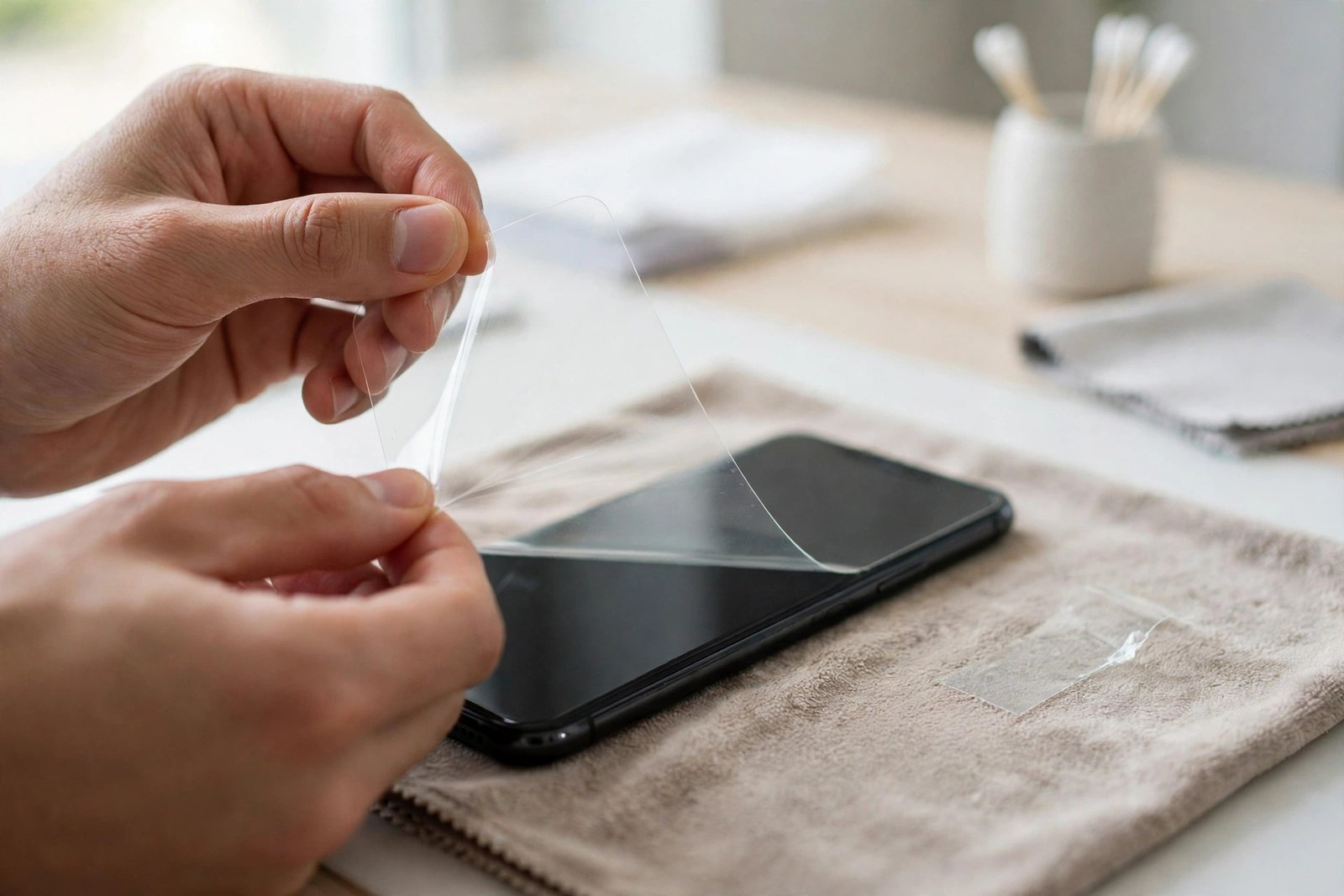
Take the case off and look at all four corners. The loosest one — often with a faint pale line where the bond has already given up — is your start. Slide a fingernail flat into the seam, or press tape onto the corner as a handle, and lift just a few millimetres. That’s all you need before the peel proper begins.
Work with the phone on a flat, soft surface, screen up, and make sure it’s warm from recent use rather than cold from a drawer. From here, the method splits — because the next thirty seconds look quite different depending on whether that lifted corner is floppy film or rigid glass.
- Can’t tell which material you have? Tap the corner with a fingernail — glass clicks, film thuds softly. Knowing matters before you pull.
- Warm a stubborn corner with a hairdryer on its lowest setting for 20 seconds, kept moving — never parked in one spot.
Film: Expect It to Stretch
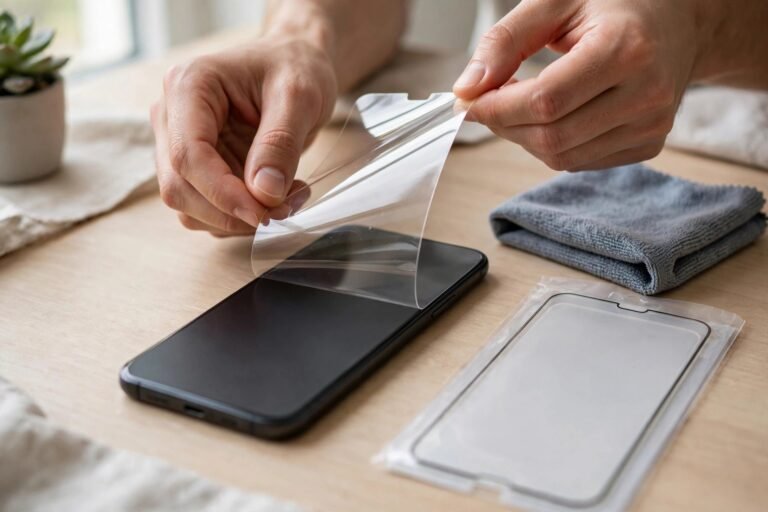
A film protector yields as you pull it, and that stretch is the trap: tension it like a rubber band and it will neck down and tear, leaving a bonded strip behind. Grip close to the peel line, pull slowly with low, even tension, and advance in short stages — a few centimetres, reposition, repeat.
If it does tear, press tape over the remaining strip’s edge to make a fresh handle and continue at a shallower angle. Film is forgiving about one thing, though: it can’t shatter. A slow film removal is untidy at worst, never sharp.
Glass: Keep It Flat or It Snaps
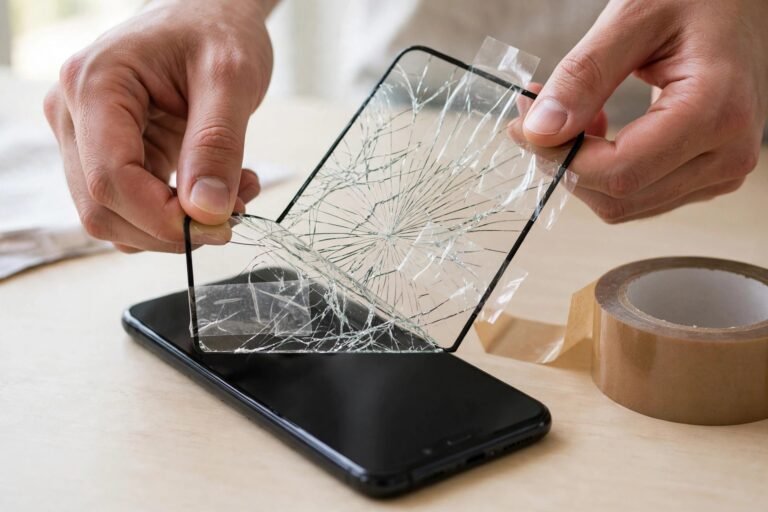
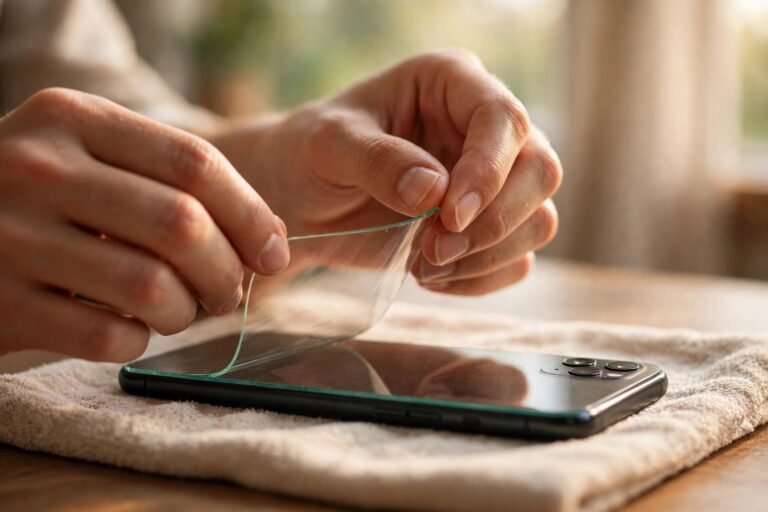
Tempered glass has no stretch at all — its only failure mode is bending. Peel it back over itself at a low angle, supporting the freed pane with your free hand so it never dangles and flexes under its own weight. Done right, the whole pane lifts in one stiff, satisfying sheet.
If the glass is already cracked, stop: cover it fully with packing tape before you lift a corner, so the fragments travel as one taped piece instead of scattering. And if you hear a crack mid-peel, pause, tape over the break, and continue even more slowly.
- Peel glass towards the corner furthest from any chip — existing damage is where a snap will start.
- Lay a sheet of paper under the phone before removing glass; any stray fragment lands on paper you can fold up and bin.
Disposal and What Comes Next
Film is simple: it’s a spent sheet of plastic — it goes straight into household rubbish. Glass needs a moment’s courtesy: fold it into a sheet of paper or wrap its edges in tape before binning, so nobody handling the rubbish meets a sharp edge. Wash your hands after handling a cracked pane; glass dust is fine and invisible.
Neither protector can go back on — the adhesive is spent and contaminated the moment it leaves the screen. Wipe the bare glass down, inspect it under a lamp, and you’re ready for the replacement. Start to finish, the whole job has taken about five minutes.
Frequently Asked Questions
Can I use the same method on a tablet?
Yes — the principles are identical, but a bigger screen means a longer peel. Work in stages, keep the tablet flat on a towel, and be extra careful with glass: a large pane flexes more, so support it with both hands as it releases.
What if the corner simply won’t lift?
Warmth first — use the device for ten minutes and try again. Then a plastic card edge worked in flat, or the tape handle. Never reach for anything metal; a slipped blade scratches the screen you’re trying to protect.
The protector left sticky marks on the screen. Are they permanent?
No. The outline is aged adhesive and grime, and it rolls off under a fingertip or wipes away with a slightly damp microfibre cloth. Buff dry and check under a lamp — the glass itself is unmarked.
One corner, one slow peel — film managed gently so it doesn’t tear, glass kept flat so it doesn’t snap. Learn which material you’re holding, and removal is a five-minute non-event.