

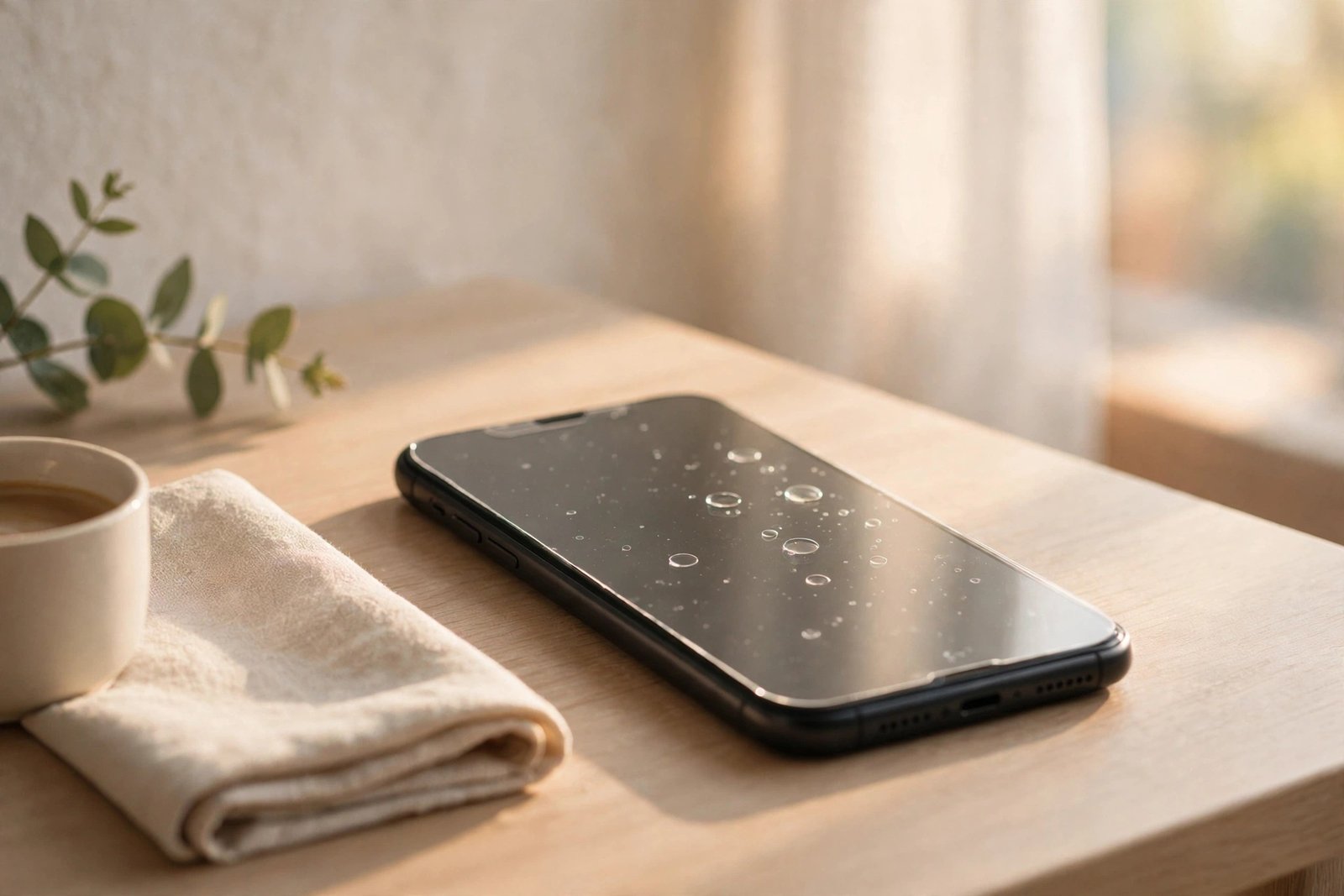
You have just fitted a new screen protector, and there they are: a constellation of bubbles staring back at you. Your first instinct is probably to start pushing at them with a card — or worse, to peel the whole thing off and start again. Before you do either, it is worth knowing the honest truth: many of those bubbles will disappear entirely on their own, and the ones that will not can be identified at a glance.
This guide gives you the real timelines, not the optimistic ones. It explains why bubbles settle at all, how long tempered glass takes compared with film, and — just as importantly — which bubbles are never going anywhere so you can fix them properly instead of waiting in vain.
Key Takeaways
- Tempered glass bubbles usually settle within 24–48 hours as the adhesive finishes flowing and bonds.
- Film protectors can take up to a week to fully settle — they are slower, but most small bubbles do vanish.
- A bubble with a visible speck in the centre will never settle. That is trapped dust, and it needs a different fix.
- Warmth speeds settling up; a phone left in a cold room or car settles noticeably more slowly.
- If a bubble looks identical after its deadline, stop waiting — it is telling you something is underneath it.
Why Bubbles Settle at All
Screen protector adhesive is not fully set the moment you lay the protector down. For the first day or two it behaves a little like a very thick liquid: it continues to flow, microscopically, creeping into full contact with the glass beneath. As it does, small pockets of trapped air get absorbed at the edges of each bubble, and the bubble shrinks from the outside in.
Normal phone use helps the process along. The warmth from the screen, from charging, and from simply being in your pocket keeps the adhesive supple, and the gentle pressure of everyday handling works it into complete contact. This is why a protector that looked disappointing on Monday evening often looks flawless by Wednesday morning — nothing was done to it; it simply finished installing itself.
Tempered Glass: The 24–48 Hour Window
Tempered glass protectors use a full-coverage silicone adhesive layer, and they settle relatively quickly. Most small bubbles — the soft, round kind with nothing visible inside them — will shrink visibly within the first 24 hours and be gone entirely by 48. Larger bubbles near the centre may take the full two days; bubbles right at the edge sometimes disappear within hours as the adhesive front reaches them.
The practical rule for glass: fit it in the evening, judge it two mornings later. Checking every hour only tempts you to intervene, and intervention — especially peeling corners back up — is the main way a settling protector gets ruined. If the bubbles are smaller than they were yesterday, the process is working. Leave it alone.
- Take a photo of the bubbles straight after fitting, then compare at 24 and 48 hours. Shrinking bubbles are settling bubbles — your eyes alone will miss the gradual change.
- Resist putting a tight case on immediately; a case lip pressing on the edge can hold a bubble open. Give it a day caseless if you can.
Film Protectors: Give It a Week
Film (PET or TPU) protectors settle more slowly, and it is only fair to judge them by a different clock. Their adhesive is thinner, and film itself is flexible, so bubbles migrate rather than absorb: they creep gradually toward the edges over three to seven days. It is quite normal for a film protector to look worse than glass on day one and end up just as clean.
You can legitimately help a film protector along in a way you should not with glass: once a day, run a soft cloth firmly over the surface, stroking from the centre outwards. This nudges migrating bubbles toward the border and encourages them out. Do not chase individual bubbles with a hard card edge — on film, that tends to stretch the material and crease it.
The Bubbles That Never Settle
Three kinds of bubble will still be there, unchanged, long after every deadline has passed. The first is the dust bubble: look closely and you will see a tiny speck — a dot, a fibre, a hair — sitting in the middle, often surrounded by a faint ring like a crater. The speck is physically tenting the protector up, and no amount of adhesive flow can flow around a solid object.
The second is the edge or halo bubble, a pale crescent where the edge of the protector refuses to lie flat. This usually means the screen curves away beneath it, or the case is levering the edge up — geometry, not patience, is the problem. The third is a bubble caused by a fingerprint on the adhesive side, which shows as a cloudy, ill-defined patch that never sharpens or shrinks. All three need action, not time.
- To spot dust, turn the screen off and tilt the phone under a lamp. A speck in the centre of a bubble catches the light and gives itself away instantly.
- A bubble that has not changed size at all in 48 hours (glass) or a week (film) has told you everything: lift the nearest corner with tape, dab the speck away with a dust sticker, and lay it back down.
How to Judge Yours: A Simple Timeline
- Just fitted: note the bubbles, photograph them, and walk away.
- 24 hours (glass): most small bubbles should be shrinking or gone. Film users: expect slow change only.
- 48 hours (glass): verdict time. Anything identical to the photo is permanent without intervention.
- 7 days (film): the same verdict — whatever remains now is dust, edge lift, or a fitting flaw.
- Any time: a bubble with a visible speck, a cloudy patch, or a lifting edge will not settle — fix it whenever you like.
Frequently Asked Questions
Does pressing the bubbles help them settle faster?
A single gentle press with a fingertip, pushing a fresh bubble toward the nearest edge, is fine and can finish the job for plain air bubbles. What does not help is repeated, forceful card work: on a still-settling protector, aggressive pushing disturbs the adhesive and can drag dust under the edge, creating worse bubbles than the ones you started with.
Why did a bubble appear a day after a perfect install?
Usually one of two things happened: the case went on and its lip nudged an edge of the protector, letting air creep in, or a slow-settling bubble shrank unevenly and became more visible against the screen as its neighbours vanished. Check the case first — if the bubble hugs the edge where the case grips, that is your culprit.
Can a hairdryer speed up settling?
It is not worth the risk. Gentle warmth genuinely does help adhesive flow, which is why a phone in a warm pocket settles faster than one in a cold car — but a hairdryer can easily overheat the adhesive and the phone’s own internals, and can make film protectors warp. Normal body warmth and patience achieve the same result safely.
Most bubbles are not a failed install — they are an install that has not finished yet. Give glass two days and film a week, learn to spot the speck that means dust, and you will rarely need to fix anything at all.


