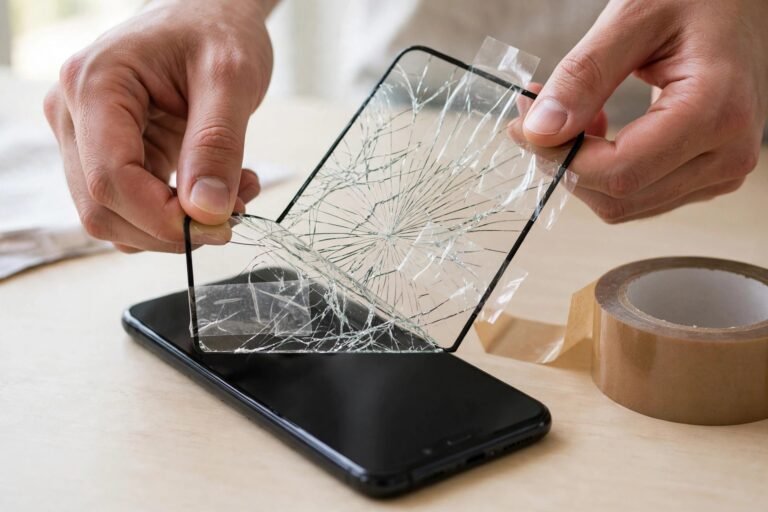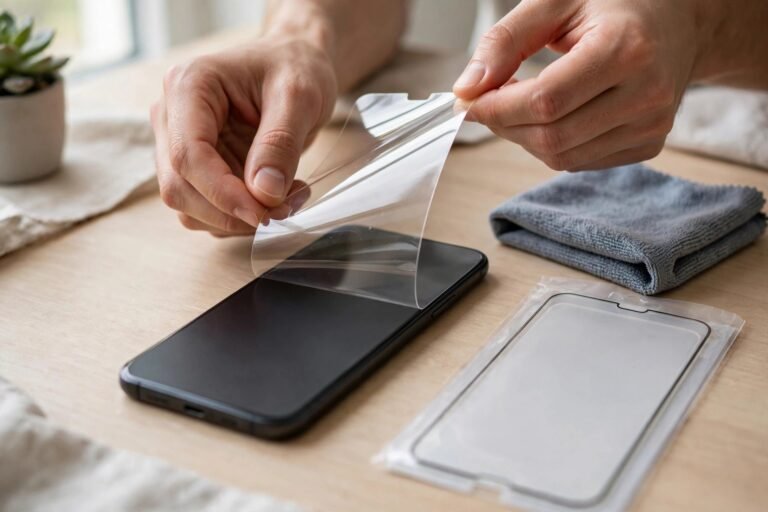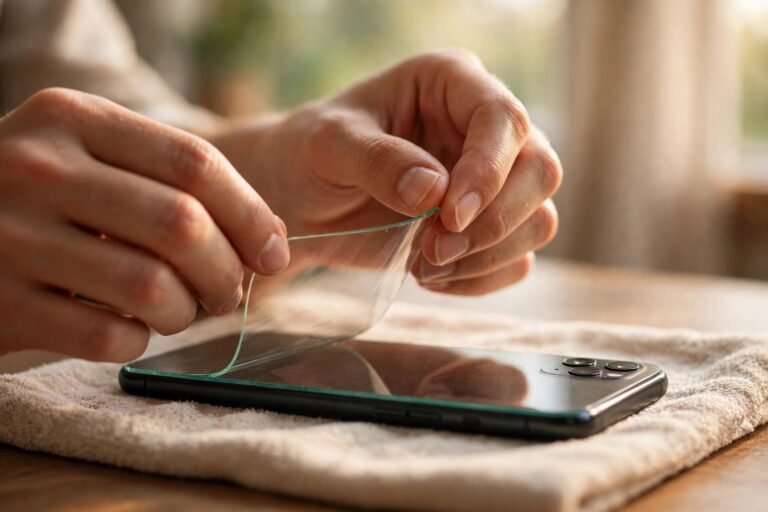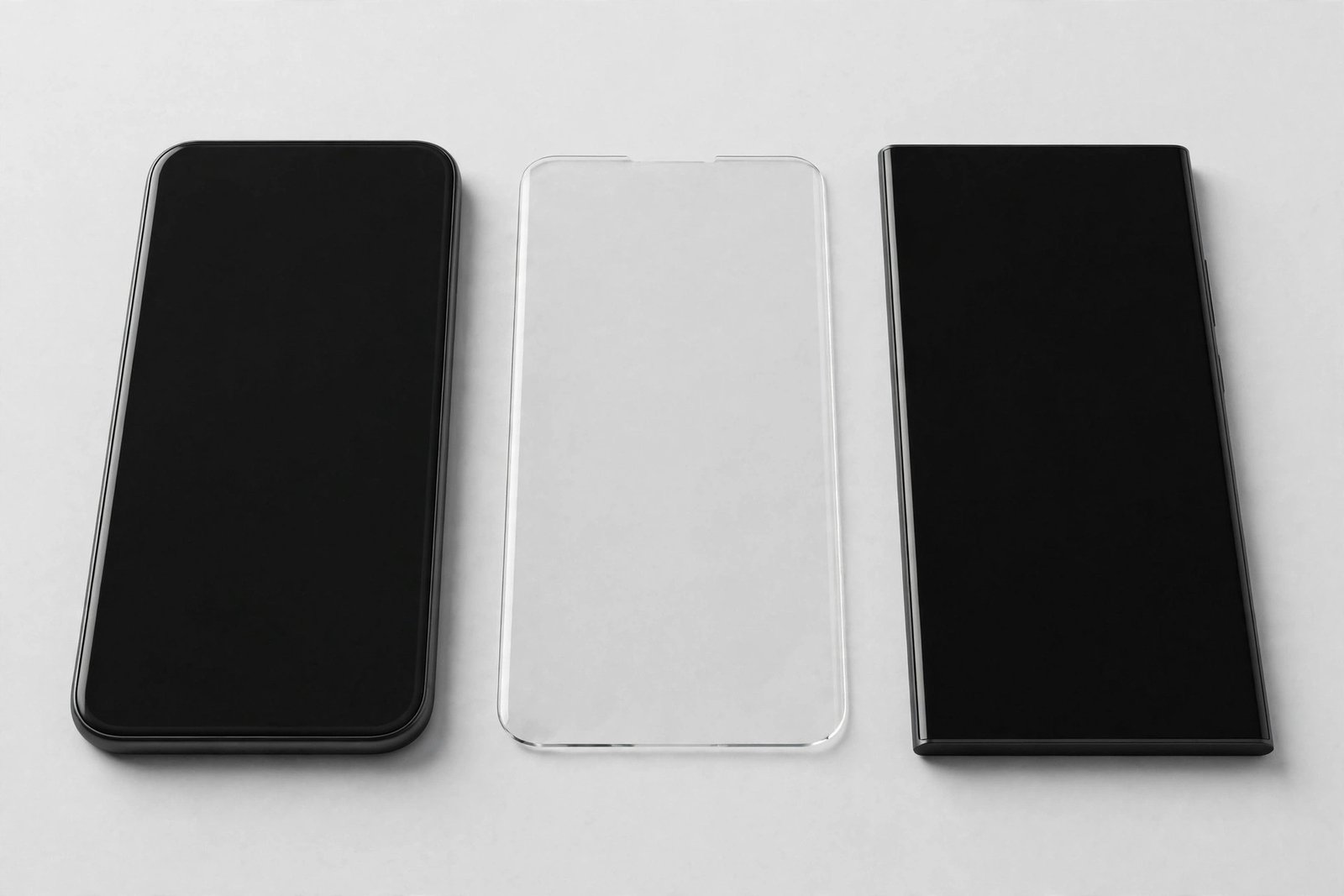
Both phones say “6.1-inch” on the box, both have a notch, and you have a spare iPhone 12 protector in a drawer while your iPhone 11’s protector has just cracked. It is a very tempting experiment. Unfortunately, the short answer is no — an iPhone 12 screen protector does not properly fit an iPhone 11, and the shared screen size is exactly what makes the mismatch so deceptive.
This guide explains why two phones with the same headline display size take different protectors, what actually goes wrong if you try the swap (in either direction), and how to check compatibility properly before you buy — so the spare in the drawer stays a spare for the right phone.
Key Takeaways
- Same screen size, different phone. The iPhone 12 is noticeably narrower and shorter than the iPhone 11 despite the identical 6.1-inch label.
- A 12 protector on an 11 comes up short — too narrow and too short, leaving exposed borders of real screen all the way round.
- An 11 protector on a 12 overhangs — its edges float past the narrower body, refuse to seal, and clash with cases.
- The design changed, not just the dimensions. The 11 is rounded with an LCD and thick bezels; the 12 is flat-edged with an OLED and slim bezels — so the glass outline differs too.
- Buy by exact model name, never by inches. Screen size is a diagonal measurement, not a promise that two phones share a shape.
Same Screen Size, Different Phone
Put the two phones side by side and the numbers tell the story. The iPhone 11 measures roughly 150.9 mm tall and 75.7 mm wide. The iPhone 12 measures about 146.7 mm tall and 71.5 mm wide — over 4 mm narrower, a difference you can see across a room. Both displays are described as 6.1 inches because the diagonal is similar, but the iPhone 11’s LCD panel sits inside a larger, rounded body with chunkier bezels, while the iPhone 12’s OLED fills a slimmer, flat-sided frame.
A tempered glass protector is cut to the millimetre for one specific front face. It is not a rough rectangle sized by screen diagonal; its outline follows the bezel line, its cutouts follow the speaker and sensors, and its adhesive area assumes a particular flat surface. Change any of those by 4 mm — an eternity in protector terms — and “close enough” stops being close at all.
- The notch is a red herring here. The two notches look alike, which makes the pairing feel plausible — but the protector fails on outline and coverage long before the notch gets a say.
- If a listing says “fits iPhone 11 / 12” for a glass protector, be suspicious. Reputable makers cut these phones separately, because physically they must.
What Happens If You Try It Anyway
iPhone 12 protector on an iPhone 11: the glass goes on, and at a glance it looks plausible — which is the trap. It is too narrow and too short, so a border of bare, unprotected screen runs around every edge, precisely where pocket grit and face-down slides do their work. The visible mismatch also means the protector’s edges sit on display area rather than bezel, collecting dust lines and looking permanently off-centre no matter how carefully you align it.
iPhone 11 protector on an iPhone 12 (the reverse swap) is worse: the pane is wider than the phone’s flat face, so its edges overhang into the curve where the 12’s front meets its flat frame. Those edges never seal — you get permanent lifted borders, a halo of unbonded glass, dust creeping underneath within days, and a case that either refuses to fit or pops the protector off the first time you squeeze it on.
How to Check Compatibility Before You Buy
The reliable rule is boring but absolute: match the protector to the exact model name — iPhone 11, iPhone 12, iPhone 12 Pro (which does share the 12’s body) — and ignore screen-size claims entirely. If you are unsure which model you own, check Settings > General > About rather than guessing from the size in your hand, because the 11 and 12 feel deceptively similar in a case.
Be careful with the few genuine exceptions. Some ultra-thin film protectors are sold as multi-model because flexible film tolerates a millimetre of slack that glass cannot — but even then, a film cut for the wider 11 will wrinkle at the 12’s edges. And “universal” cut-to-fit sheets exist for emergencies, not as a plan. A model-correct protector costs the same as the wrong one; the only thing the wrong one saves you is the wait for delivery, and it charges you exposed edges for it.
- Genuinely stuck with a cracked 11 protector and only a 12 spare? As a temporary measure for a day or two, the undersized 12 glass at least covers the central display — but treat it as a plaster, not a fix, and order the correct one immediately.
- Keep spares labelled. Protector boxes for different generations look identical in a drawer, and future-you will not remember which is which.
Frequently Asked Questions
The phones are both 6.1 inches — how can the protectors differ?
Because 6.1 inches is only the screen’s diagonal. The iPhone 11 wraps that diagonal in a taller, wider, rounded body with thick bezels; the iPhone 12 wraps it in a compact flat frame with thin bezels. Protectors are cut to the body and bezel outline, not to the diagonal — and those outlines differ by several millimetres.
Will an iPhone XR protector fit an iPhone 11?
Yes — this is the pairing that does work. The XR and 11 share the same body dimensions and front design, so their protectors are genuinely interchangeable and are often sold as a single XR/11 listing. It is the exception that proves the rule: shared body, shared protector.
Does an iPhone 12 protector fit the iPhone 12 Pro?
Yes. The 12 and 12 Pro have identical front dimensions, so protectors are fully interchangeable between them and are normally listed together. Confusion only starts when a different generation — the 11 on one side or the 13 on the other — enters the picture.
“Same size screen” is a diagonal, not a destiny. The iPhone 11 and 12 are different shapes wearing similar numbers — give each the protector cut for its own face.