

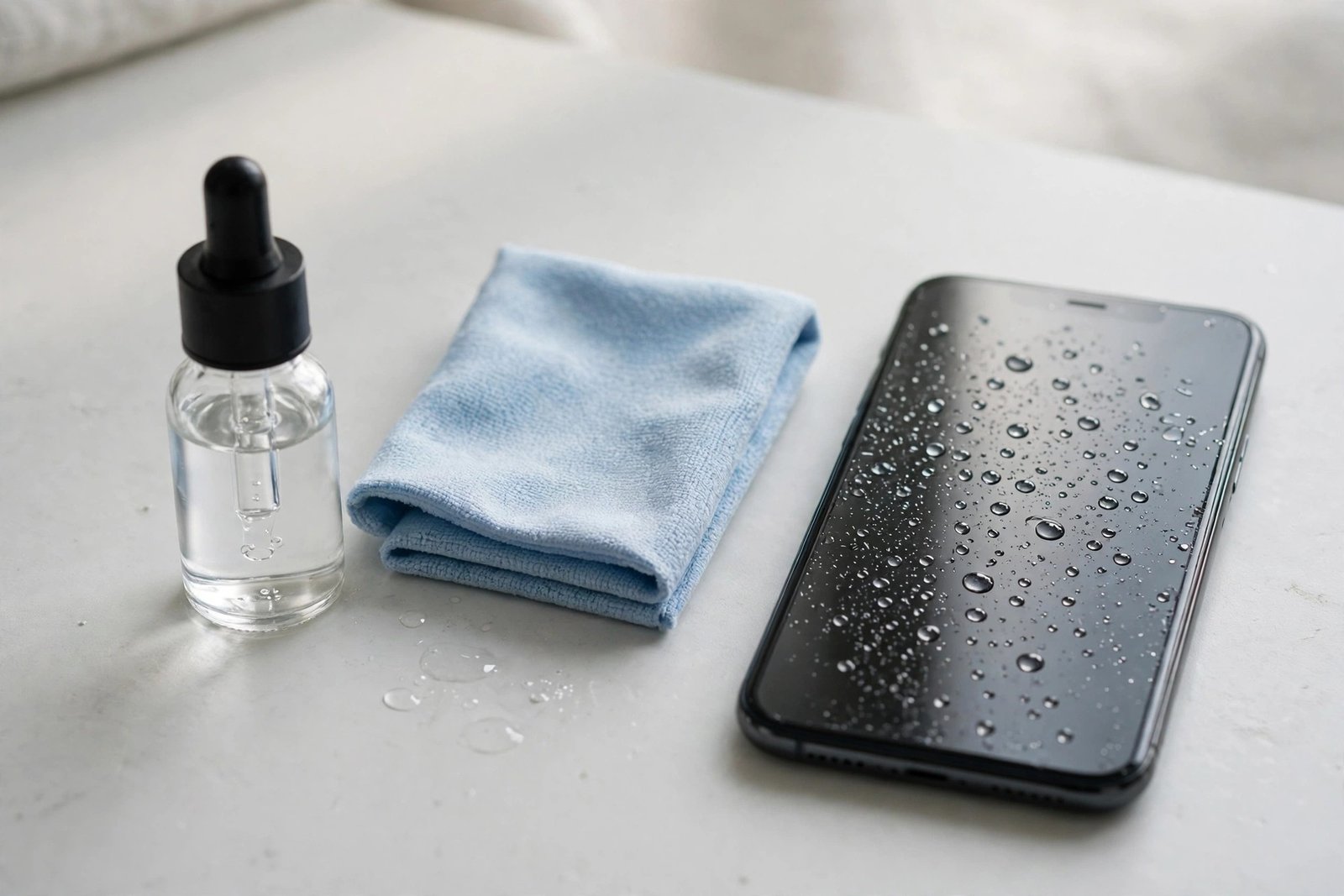
Liquid glass screen protectors sound almost magical: wipe on an invisible coating, and your screen is supposedly armoured against scratches and drops. The reality is more modest and more interesting. These products do something real — they add a very thin, hard-wearing layer that helps against the finest everyday scratches — but the leap from that to drop protection is marketing, not physics.
This guide explains what a liquid coating actually is, what it can and cannot do, why the hardness claims deserve scepticism, and who it genuinely suits. If you are choosing between a liquid coating and a tempered glass protector, understanding the thickness difference — measured in nanometres versus millimetres — explains almost everything.
Key Takeaways
- Liquid protectors are nano-coatings — a layer thousands of times thinner than a tempered glass protector.
- They help with fine scratches by filling micro-grooves and adding a slick, slightly harder surface.
- They offer no meaningful drop protection — there is simply not enough material to absorb impact energy.
- Treat headline hardness claims cautiously: test conditions for coatings differ greatly from those for solid glass.
- The coating wears away gradually over months and cannot be peeled off and inspected like a physical protector.
- Best suited to minimalists and curved or in-display-fingerprint devices where a physical protector fits awkwardly.
What a Liquid Screen Protector Actually Is
Most liquid protectors are based on silicon dioxide — the main ingredient of glass — suspended in a solvent. You wipe the liquid across a clean screen, it spreads into the microscopic texture of the surface, and as the solvent evaporates and the layer cures, it bonds into a continuous film. That final film is extraordinarily thin, typically described in nanometres. For comparison, a tempered glass protector is roughly a third of a millimetre thick — several thousand times more material. Both are, in a loose sense, “glass on your screen”, but they are as different in protective terms as a coat of paint is from a wooden door.
Because the coating flows into the surface, it does two useful things. It fills the finest micro-scratches already present, making them less visible, and it leaves a smooth finish that resists fingerprints. Some products include a replacement-assurance scheme; terms vary widely between brands and over time, so read the current conditions carefully rather than treating them as insurance.
Scratches: Where It Helps, and Where It Stops
Against the lightest damage — hairline micro-abrasion from fabric, dust, and gentle contact — a cured coating offers a genuine, modest benefit. The added layer takes the first contact, and its even surface shows fewer faint marks. Owners who hate the feel of physical protectors often find this an acceptable trade: not strong protection, but better than bare glass for cosmetic wear.
Against anything more serious, be sceptical. A grain of sand dragged across the screen applies force that a nanometre-scale film cannot meaningfully resist; it will cut through the coating and mark the glass beneath. Keys, drops onto grit, and workshop or beach environments are all well beyond a coating’s pay grade. You also cannot verify the coating’s condition: there is no edge to inspect and no layer to peel back, so you never truly know how much of it remains after months of pockets, cleaning, and alcohol-based wipes, all of which gradually wear it down.
- Judge a liquid coating as scratch cosmetics, not armour: if it keeps a careful user’s screen looking fresher for longer, it has done its real job.
- Application quality decides everything — degrease the screen thoroughly and follow the curing time exactly; a coating wiped over fingerprints protects the fingerprints.
The Drop Protection Claim, Examined Honestly
Impact protection needs material that can deform, spread force, and sacrifice itself — which is precisely what a tempered glass protector does when it cracks in place of your screen. A liquid coating has no thickness to deform with and nothing to sacrifice; the energy of a drop passes through it essentially unchanged. No coating measured in nanometres can alter the outcome of a phone landing face-down on concrete, and you should treat any suggestion otherwise as a red flag about the seller rather than a feature of the product.
The same caution applies to hardness ratings. A figure quoted for a cured coating is measured under test conditions for thin films and is not comparable to solid tempered glass of the same nominal rating. Hardness is not toughness: hard materials still shatter if they cannot absorb energy. When a listing leads with a big hardness number and drop language, the number is doing marketing work. Independent tests consistently find a small improvement over bare glass — real, but small.
Who a Liquid Protector Actually Suits
A liquid coating is a reasonable choice for a careful owner who dislikes physical protectors, keeps their phone in a case with a raised lip, works in a clean environment, and mainly wants to slow cosmetic micro-wear while keeping the screen feeling exactly as the manufacturer made it. It is also a pragmatic option for strongly curved screens and some in-display fingerprint readers, where physical protectors can lift at the edges or interfere with unlocking — a coating adds no edge and no thickness, so compatibility is total.
It is a poor choice as your only protection if the phone is shared with children, used outdoors, carried loose with keys, or if a cracked screen would be a serious problem. Those situations call for tempered glass. Note too that a liquid layer is effectively permanent until it wears off — it cannot be removed on demand — so apply it because you want it, not as a trial.
- If you reapply liquid coating periodically, keep a note of the date — makers’ suggested reapplication intervals vary, and an undated coating is easy to over-trust.
- Do not apply a liquid coating over a cracked screen expecting it to seal or strengthen the damage; it cannot, and the cracks remain a repair question.
Frequently Asked Questions
Can you use a liquid coating and a glass protector together?
You physically can, and some owners apply a coating first to fill micro-scratches, then fit glass over the top for real protection. It does no harm, provided the coating has fully cured before the protector goes on. Just be clear-eyed about the division of labour: in that combination, the tempered glass is providing essentially all of the impact and scratch protection, and the coating is contributing a minor cosmetic fill underneath.
How long does a liquid screen protector last?
Makers commonly suggest the effect lasts somewhere in the region of several months to around a year, but honest precision is impossible: pockets, cleaning products, hand sanitisers, and how often the screen is wiped all wear the layer at different rates, and there is no way to inspect what remains. Treat any single lifespan figure as optimistic, assume protection fades gradually rather than ending on a date, and reapply on the maker’s schedule if you rely on it.
Does a liquid protector affect touch or fingerprint unlocking?
No — and this is one of its genuine advantages. Because the layer is so thin, touch sensitivity, display clarity, and both optical and ultrasonic in-display fingerprint readers work exactly as they do on bare glass. If you have ever had a thick or poorly fitted glass protector make unlocking unreliable, a coating avoids that problem entirely, at the cost of the much lower protection described throughout this guide.
Liquid glass works — just at a much smaller scale than the boldest claims suggest: real help against the finest scratches, none against drops, and best chosen knowingly by careful owners who value feel over armour.


