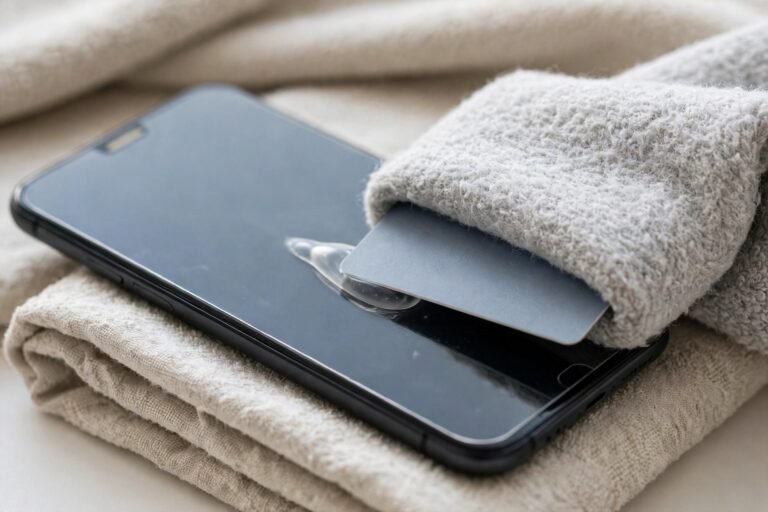
The install looked flawless. You checked it from every angle, put the case back on, and got on with your week. Then, days later, there it is: a bubble under the screen protector that definitely was not there before — or was it? Late-appearing bubbles unsettle people because they suggest something is going wrong underneath the glass.
Usually, nothing is going wrong. A bubble that surfaces days after fitting has ordinary causes — settling adhesive, temperature changes, case pressure — and in most cases it can be pressed out without lifting the protector at all. This guide explains why late bubbles appear, the press-and-hold method that removes most of them, and how to reseal the edges afterwards so they stay gone.
Key Takeaways
- Late bubbles are usually caused by settling adhesive, temperature swings, or a case pressing on an edge — not by a faulty protector.
- Most can be removed with the press-and-hold method: warm thumb pressure, held, then walked slowly to the nearest edge.
- Lifting the protector is a last resort. Every lift weakens the adhesive and risks letting dust underneath.
- After removing a late bubble, reseal the edges — run firm pressure around the whole border to restore full contact.
- If the same bubble returns in the same place, suspect the case, not the protector, and test by leaving the case off overnight.
Why Bubbles Appear Days Later
Protector adhesive does not finish its work the moment you fit the glass. For the first several days it continues to flow microscopically, wetting out across the screen — and as it does, tiny amounts of air that were spread too thin to see can gather into a pocket large enough to become visible. What looks like a new bubble is often old air, collected.
Temperature is the other common trigger. A phone that warms in a pocket and cools on a desk expands and contracts minutely, and a case pressing on one edge can prise the glass up by a fraction — just enough for air to creep under the border and show itself as a crescent along one side. None of this means the protector has failed; it means the system of glass, adhesive, case and temperature has shifted slightly since fitting day.
Try Press-and-Hold Before Anything Else
Because the adhesive has already set around a late bubble, brute pushing is less effective than it is on a fresh install. The method that works is slower: place a warm thumb or a cloth-wrapped fingertip directly on the bubble and press firmly for thirty to sixty seconds. The combination of warmth and sustained pressure persuades the adhesive to flow again and lets the air start migrating.
Once the bubble begins to move, walk it towards the nearest edge in small stages — press, hold, shift a few millimetres, hold again — rather than one long stroke. On a set adhesive, steady patience beats force: a bubble that refuses a hard push will often creep obligingly under repeated gentle ones. Work with the case off, so nothing is prising the destination edge up while you aim for it.
- Do press-and-hold work when the phone is slightly warm from use — a cold phone on a cold morning has the stiffest adhesive of the day.
- Mark the bubble’s edge with a tiny dot of whiteboard marker on top of the glass. If the outline shrinks between sessions, your method is working even when progress feels invisible.
When Lifting Is the Only Option Left
Occasionally a late bubble will not move because it is not air at all — a speck of dust has worked under a lifting edge, or settled there during a moment the edge was up. No pressing fixes dust. If the bubble has a visible dark centre and has survived two or three honest press-and-hold sessions, lifting the nearest corner is justified.
Do it minimally: stick tape to the corner nearest the bubble, lift only far enough to reach the spot, dab the speck away with a dust-removal sticker, and lower the glass back down, smoothing from the lift point outwards. Every lift costs adhesive strength and invites new dust, so treat it as surgery — once, carefully, in the steamiest room you have — not as a routine adjustment.
Reseal the Edges So It Stays Fixed
Removing the bubble is only half the job; the other half is stopping the next one. Run a cloth-wrapped fingertip firmly around the entire border of the protector, pressing each edge down in turn and holding the corners for a few seconds each. This reseats any section that had begun to lift and restores the seal that keeps air out in the first place.
Then leave the case off for a few hours — overnight is ideal — so the resealed edges cure undisturbed. Check the screen the next morning under a lamp. If the bubble has gone and the borders sit flat, the fix has taken. If the bubble reappears along the same edge, the case is lifting it: the honest cure is a case-friendly protector or a case with a slimmer lip, not another round of pressing.
- Photograph the screen before and after each session. Late bubbles shrink gradually, and a photo proves progress your eyes adapt to and miss.
- A bubble that appears only after the phone has been in a hot car or direct sun is thermal — let the phone cool fully before pressing, or you will chase it in circles.
Frequently Asked Questions
Does a bubble appearing days later mean the protector is faulty?
Almost never. Late bubbles are a normal part of how adhesive settles, and they appear under protectors of every quality level. A protector that aligns well, otherwise sits flat, and clears with press-and-hold is doing its job. Faulty glass shows itself differently — edges that never adhered from day one, or a pane visibly warped out of flat.
Will lifting a corner ruin the adhesive?
One careful lift, done soon after fitting and kept as small as possible, usually leaves the adhesive serviceable — the glass goes back down and holds. Repeated lifts are the problem: each one weakens the bond, dulls the edge’s grip, and raises the chance of dust. Lift once, for a clear reason, and make it count.
The bubble is under the middle of the screen. Can it still be pressed out?
Yes, but it is the slowest kind, because the air has the longest journey to an edge. Use press-and-hold in stages, moving the pocket a few millimetres at a time towards the nearest border, over several sessions if needed. A centre bubble that shrinks steadily is progressing fine; only one that grows, or shows a speck at its heart, needs the lift treatment instead.
A bubble that appears days later is not a protector failing — it is adhesive settling, air gathering, and edges asking to be resealed. Press, hold, reseal, and it will almost always stay gone.