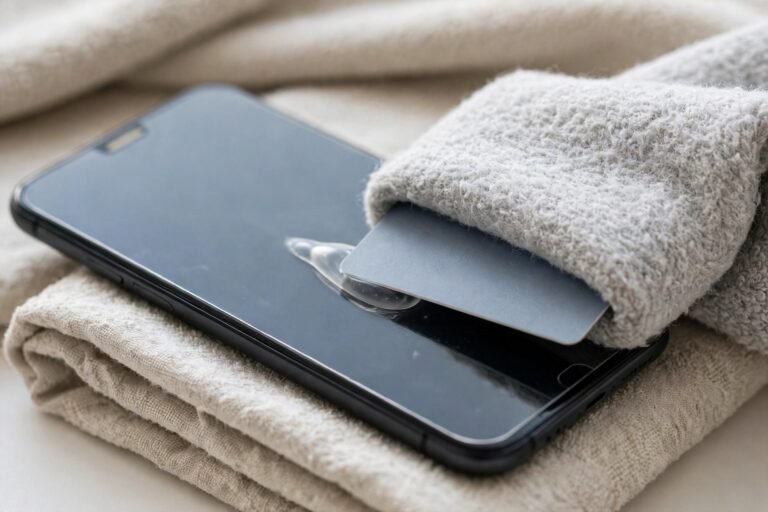
Flexible film plays by different rules from glass. It bends, it gives a little under your thumb, and it shows every bubble honestly — but it also lets you fix them in ways glass never will, because a squeegee can chase air across a film in one continuous sweep. Most bubbles in a film protector aren’t a fitting failure; they’re a technique issue, and technique can be corrected even after the film is already down.
This guide is about film protectors specifically — the thin, flexible kind, not tempered glass. It covers the squeegee technique that clears bubbles properly, how wet-apply and dry-apply films behave differently once they’re on, and the film-only problems, like creases and stretching, that no amount of squeegeeing will cure.
Key Takeaways
- Film is fixed with a squeegee, not fingertips — fingers push unevenly and leave channels of air behind.
- Work from the centre outwards in overlapping strokes, so air always has an escape route ahead of it.
- Wet-apply film can be slid into place and its bubbles squeegeed out with the solution; dry film bonds on contact.
- A bubble with a crease through it won’t press out — the film itself is folded, not air trapped.
- Small bubbles in fresh film often dry out and vanish in a day or two, especially with wet-apply types.
- Never stretch film to make it reach an edge; stretched film creeps back and takes the seal with it.
Why Film Traps Bubbles Differently from Glass
Glass is rigid, so it drops flat in one movement and its adhesive does the spreading. Film is laid down progressively, edge to edge, and that rolling contact line is exactly where air gets caught: lay a section down a fraction too fast and a pocket is sealed in before the squeegee ever reaches it. Film also conforms to the screen rather than bridging over it, so dust shows as a smaller, tighter mark than it would under glass — but it also means air can hide in long, thin channels along your stroke direction. The compensating virtue is that film stays workable. Its bond is gentler than glass adhesive, so bubbles can be herded around and out long after fitting, as long as the film itself isn’t damaged.
The Squeegee Technique That Actually Works
Use the squeegee from the kit, or a bank card wrapped in a microfibre cloth so its edge can’t scratch the film’s surface. Start at the centre of the screen and push outwards towards the nearest edge in short, overlapping strokes, holding the squeegee at a shallow angle and keeping the pressure firm and even. Overlap each stroke by about half, like mowing a lawn in strips, so no corridor of air gets left between passes. Work one quadrant of the screen at a time, and always finish a stroke at an edge — stopping mid-screen leaves a ridge of air exactly where you stopped.
For bubbles that are already there, use the same motion in miniature: set the squeegee just behind the bubble and walk it to the nearest edge in one unbroken push. If a bubble refuses to travel because the film has fully settled around it, film gives you a second chance glass doesn’t — lift the nearest edge of the film a little with a strip of tape, squeegee the pocket out from underneath as you lay it back down, and press the edge home.
- Squeegee before you peel off the top release liner if your film has one — the liner stiffens the film and gives the squeegee something solid to push against.
- For wet-apply film, a light mist of solution on your fingertips stops them sticking to the film while you hold it in place.
Wet-Apply vs Dry-Apply Film
The two film families look identical in the packet and behave nothing alike. Wet-apply film goes down on a fine mist of solution, which lets you slide it into perfect alignment before committing. Its fresh bubbles are mostly solution, not air: they look hazy and milky, and the correct treatment is to squeegee the excess liquid out to the edges and then leave the rest alone — the remaining micro-bubbles dry out and disappear over 24–48 hours, and the edges often don’t fully settle until it’s dry. Dry-apply film bonds the moment it touches, so alignment has to happen in the air, ideally with hinge tape. Its bubbles are pure air, they won’t dry away, and the squeegee is the only way out — but luckily dry film tolerates being squeegeed firmly and repeatedly.
Creases, Stretch Marks and Peeling Edges
Three film problems masquerade as bubbles but aren’t. A crease — a sharp white line running through a pale patch — means the film itself folded at some point; that fold is permanent and no squeegee will flatten it. Stretch happens when film is pulled to make it reach: it looks fine for an hour, then creeps back, wrinkling the seal and letting air in along one side. And peeling edges usually trace back to skin oil on the sticky side from handling, or to a case lip worrying at the border. Press a lifted edge down and hold it for thirty seconds; if it springs back immediately, the adhesive there is contaminated and that section will never hold.
- Handle film by its tabs and edges only — skin oil on the sticky side is the single biggest cause of edges that won’t stay down.
- If a bubble keeps reappearing along one stroke line, your squeegee pressure is uneven; slow down and let the strokes overlap more.
Frequently Asked Questions
My wet-apply film looks hazy with tiny bubbles everywhere. Is that normal?
Yes — completely. That milky haze is the application solution trapped in thousands of micro-pockets, and it’s how wet-apply film is supposed to look for the first day. Squeegee out what you can, then leave it somewhere at room temperature. Within 24–48 hours the solution dries through the film and the haze clears. Chasing it with hard squeegeeing while it’s still wet usually just creases the film.
Can I lift and re-lay film if it goes on crooked?
Wet-apply film, yes — while it’s still wet it can be lifted, re-misted and laid again. Dry-apply film gives you one quick lift within the first minute or so, before its adhesive takes hold; after that, lifting stretches it, and stretched film never sits flat again. If a dry film has been down for an hour and it’s crooked, a fresh piece will give you a better result than a rescue attempt.
The film has been on for a week. Can its bubbles still be fixed?
Air bubbles, usually yes — film stays squeegee-friendly far longer than glass, and a week-old air pocket will often still walk out to the edge. A dust bubble at a week old is a harder job, because the lift it needs weakens adhesive that has fully settled, and the re-seal may not be perfect. Creases and stretch marks at any age are permanent; only a fresh piece of film fixes those.
Film forgives technique in a way glass doesn’t — but only technique. Keep the squeegee moving from the centre out, respect the difference between wet and dry, and most film bubbles are a thirty-second fix.