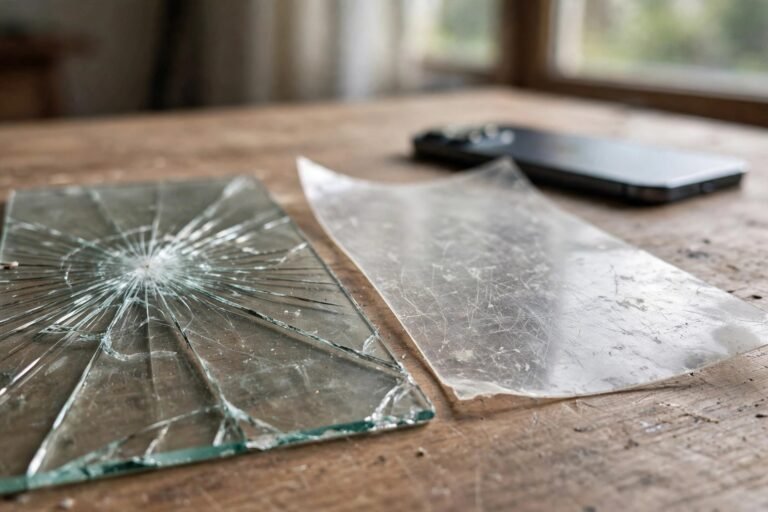
A protector picks up damage in two very different flavours. Some of it is purely cosmetic — the faint scratches and scuffs that look untidy but change nothing about how much protection you have. The rest has already spent the protector’s strength: cracks, deep chips, and lifting layers that leave your real screen far more exposed than you might think.
Knowing which side of that line your protector sits on is the whole decision. Replace too early and you waste a perfectly serviceable layer; replace too late and you are walking around with a phone that is effectively unprotected while believing otherwise. This guide walks through the damage thresholds that matter, and explains why cracked glass protects less than intact glass.
Key Takeaways
- Light surface scratches are cosmetic — they look untidy but leave the protector’s strength almost untouched.
- Any crack is a replace-now sign: cracked glass has already spent the energy-absorbing ability it was fitted for.
- Deep chips on edges and corners are stress concentrators — the next impact is far more likely to reach your screen.
- Delamination (a milky, spreading patch where layers separate) means the adhesive bond has failed and the protector can shift or trap grit.
- A protector works by sacrificing itself in one piece; once it is in pieces, that mechanism is used up.
- If you can feel a crack with a fingernail or see it catching the light, it is structural, not cosmetic.
Cosmetic Damage: Ugly but Harmless
Start with the reassuring category. Hairline surface scratches — the kind you can only see with the screen off, held at an angle under a lamp — sit in the very top of the material. They scatter a little light and dull the finish, but the layer beneath them is still whole, still bonded, and still able to do its job. The same goes for minor scuffs around the edges and a faded surface coating.
A good rule of thumb: if the damage disappears when the screen is on and you cannot feel it with a fingernail, it is cosmetic. You may still choose to replace the protector because the marks annoy you — that is a perfectly valid reason — but you are not gambling with your screen by waiting. Cosmetic wear is the protector performing exactly as intended, taking the small hits so the display does not have to.
Structural Damage: The Protector Is Spent
Cracks are different in kind, not just degree. A crack is a fracture that runs through the material, and it changes everything about how the layer behaves. The same applies to deep chips, especially at corners and edges, where a chunk of material is missing or a notch has formed. And then there is delamination: on glass protectors, a cloudy or rainbow patch where the adhesive layer has separated; on film protectors, a bubble-like blister that will not press down. In each case, part of the structure you were relying on no longer exists.
The fingernail test sorts most borderline cases. Run a nail gently across the suspect mark. If it catches, the damage has depth, and depth is what matters. Likewise, any crack that has sprouted branches, any chip you can feel as a dip, and any patch where the protector has visibly separated from the screen should be treated as structural. The protector has taken its hit. Its shift is over.
- Inspect damage with the screen off under a bright lamp — cracks that are invisible against a lit display show up immediately against black glass.
- A crack near the camera cut-out or speaker slot is more serious than it looks, because those openings are already weak points in the layer.
Why a Cracked Protector Protects Less
A tempered glass protector protects your screen mainly by sacrificial fracture. When the phone lands face-down, the protector takes the impact energy and breaks itself, spreading and absorbing force that would otherwise reach the display. That only works once, and it only works while the sheet is intact. A pane that is already cracked has pre-existing fault lines: the next impact travels straight along them, the fragments shift instead of bracing, and far more of the force passes through to the glass underneath.
Cracks also undermine the protector in quieter ways. The sharp edges of a crack can flex and grind against the real screen in your pocket. Breaks in the layer let moisture and fine grit reach the display surface. And a chipped corner is a stress concentrator — engineers have known for a century that notches and cracks are where materials fail first. In short, a cracked protector is not “half a protector”. In the ways that count, it is much closer to none.
- If money or timing means you cannot replace a cracked protector today, at least cover the crack with clear tape — it holds fragments together and keeps grit out until the new one arrives.
- When you peel a cracked protector off, do it over a bin and slowly; tape across the worst cracks first so loose shards stay attached to the sheet.
Making the Call
Boil it down to three questions. Can I feel it? If a fingernail catches, it is structural. Does it cross the viewing area or touch an edge? Cracks that reach an edge, a corner, or a cut-out have compromised the sheet’s integrity. Is any part of it separating, lifting, or cloudy from beneath? That is delamination, and it only spreads. A “yes” to any of them means replace it now; three “no”s mean the damage is cosmetic and the timing is yours to choose.
Protectors are among the cheapest insurance a phone ever gets, and they are sold in multi-packs for a reason. The expensive mistake is not replacing one too soon — it is trusting a spent one through the one drop that finally matters.
Frequently Asked Questions
There is a tiny crack in one corner that is not spreading. Can I leave it?
You can, but understand what you have: that corner is the most common impact point, and a crack there means the sheet will offer much less resistance if it lands there again. If the crack sits outside the display area and is not growing, a short delay is low-risk — but treat replacement as a this-week job, not a someday one.
The protector is cracked but my screen is fine. Did it actually work?
Very likely, yes. That is the sacrificial design doing its job: the protector absorbed and spread an impact that would otherwise have reached the display. Peel it off carefully and check the screen beneath under a lamp — in most cases it is unmarked. Then fit the fresh protector from the pack and carry on.
What about a deep scratch that I can feel but that is not a crack?
Treat it as structural-lite. A deep groove is a stress concentrator in the same way a small crack is, and it weakens the sheet along that line. If it is short and away from the edges, it is not an emergency; if it is long or near a corner, replace the protector soon rather than trusting it.
Scratches are the protector’s diary; cracks are its discharge papers. Learn to tell the two apart and you will never waste a good protector — or trust a spent one — again.