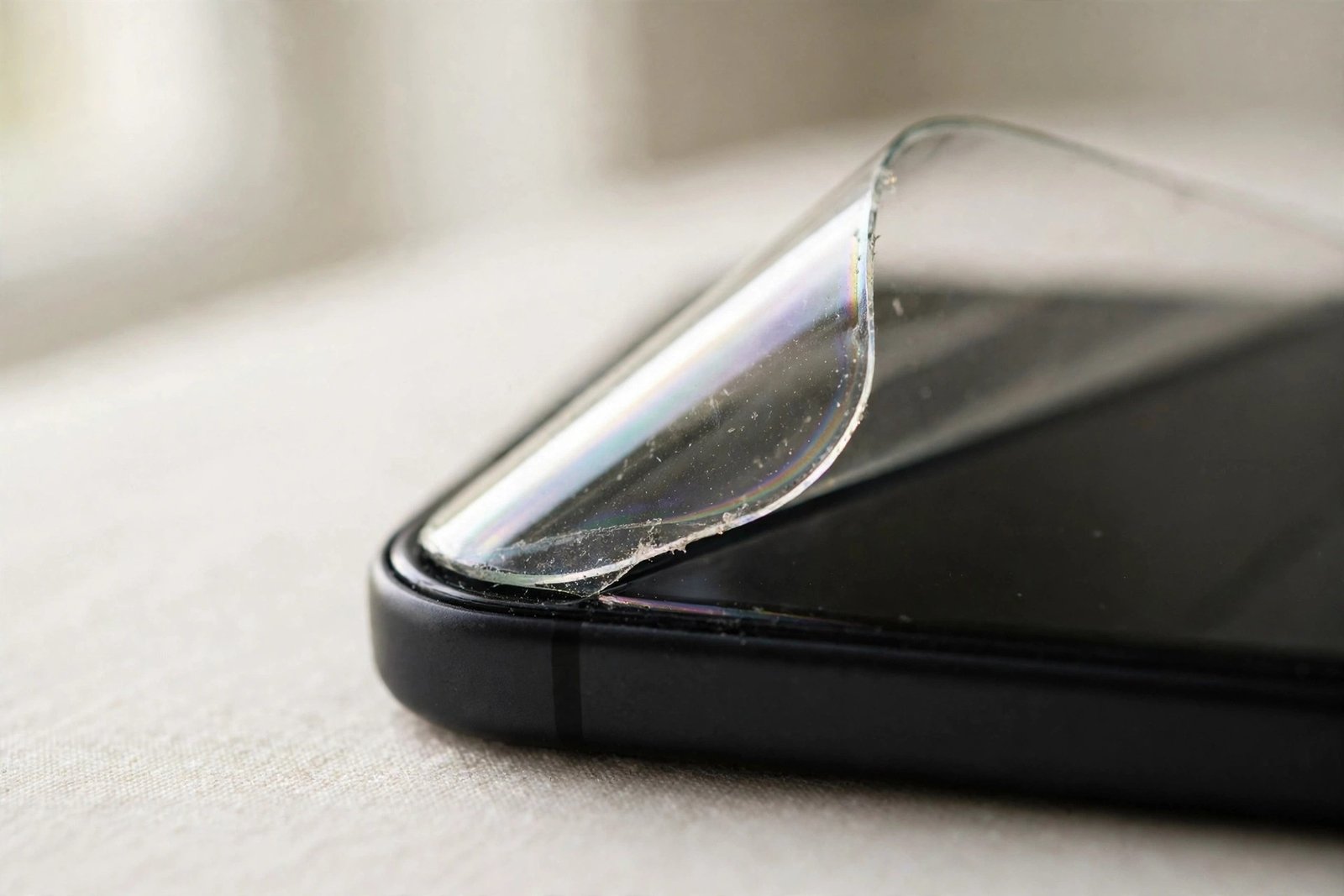
Few things are more frustrating than fitting a brand-new screen protector, standing back to admire it — and watching an edge slowly peel up, or a corner refuse to sit down no matter how firmly you press it. You’ve done nothing obviously wrong, yet the glass simply won’t stick.
The good news is that a protector that won’t stick is almost never a mystery. There are a handful of usual causes — surface contamination, curved edges, spent adhesive, interference from your case — and each has a matching fix. This guide walks through them in the order you should check them.
Key Takeaways
- The most common cause is dust, grease, or residue on the screen before fitting — the adhesive never got a clean surface to grip.
- Curved screen edges defeat flat glass: if the display curves, the glass can’t follow, and the edges lift.
- Old or cheap adhesive, and protectors that have been lifted and refitted, lose their grip permanently.
- A case lip pressing on the edge can lever a perfectly fitted protector up within hours.
- Fit in a warm, dust-free room, clean with the alcohol wipe, and use an alignment frame for the best bond.
- Never add household glue or tape to help a protector stick — it damages screens and ruins the protector.
Cause One: The Screen Wasn’t Truly Clean
Protector adhesive bonds to the surface it touches — and if that surface is a fingerprint, a film of pocket grease, or the ghost of your previous protector, the bond fails exactly there. The classic sign is a bubble or lifting patch that follows the shape of an old smudge, or edges that lift where your thumbs held the phone during fitting.
The fix is unglamorous but decisive: clean properly. Use the alcohol wipe from the kit over the whole screen, buff with the microfibre cloth, then dab the entire surface with the dust-removal sticker and inspect it at an angle under a bright light. Handle the phone by its edges afterwards, and fit the protector immediately — every minute the bare screen sits out, it collects fresh dust.
Cause Two: Curved Edges and Coated Screens
Tempered glass is flat and rigid. Many modern screens are not — they curve gently down at the edges, and a rigid sheet simply bridges over the curve, touching only in the middle. The result is the famous halo: a pale outline around the protector where the edges hover instead of bonding. No amount of pressing fixes geometry; the glass physically cannot bend to meet the screen.
Coatings cause a subtler version of the same problem. A screen wearing a liquid nano-coating, or heavy residue from one, presents a deliberately low-friction surface — excellent for repelling fingerprints, poor for holding adhesive. If you’ve recently applied a liquid coating, the protector may never bond properly until the coating has worn down or been cleaned back.
- Got a curved screen? Choose a protector made specifically for it — curved-edge glass or a flexible TPU film that wraps the curve — rather than fighting a flat sheet that was never going to fit.
Cause Three: The Adhesive Is Spent
Protector adhesive is essentially a one-shot material. Every time a protector is lifted, its sticky layer picks up dust and skin oils and loses strength; a protector that’s been peeled and refitted twice will rarely seal like a fresh one. Age matters too — a protector that’s sat in a drawer for years, or a bargain one with thin adhesive to begin with, may simply never grip well.
Environment plays a part as well. Fitting in a cold room makes adhesive less pliable and slower to wet out across the glass; damp or steamy air (helpful for dust, tricky if excessive) can interfere too. A warm, calm room, unhurried hands, and a fresh protector from a sealed pack give the adhesive its best possible chance.
Cause Four: Your Case Is Pushing It Off
Sometimes the protector sticks beautifully — until the case goes on. A case lip that overlaps the edge of a full-coverage protector levers against it constantly, and within hours or days a corner starts to lift. The tell-tale sign is lifting that always begins at the same corner, aligned with where the case grips tightest.
The remedy is to change one of the two parts: either move to a case-friendly protector cut slightly smaller than the screen, or a case with a lower lip. And whatever you do, resist improvised fixes — household glue, superglue, and tape around the edges can damage the screen’s coating, seep where they shouldn’t, and turn a £10 problem into a screen replacement. If the adhesive is genuinely spent, a fresh protector is the fix; there is no safe shortcut.
- Fit with the alignment frame if your protector came with one, and press the centre first, letting the bond spread outward on its own. Then run a firm thumb around all four edges for thirty seconds each — edges seated properly at fitting time rarely lift later.
Frequently Asked Questions
The edges lifted a day after fitting. Can I press them back down?
You can try — firm pressure for thirty seconds sometimes reseats a fresh edge. But if the cause is a curved screen, a coating, or your case, the lifting will keep returning, because the underlying problem hasn’t changed. Diagnose the cause rather than wrestling the symptom.
Can I wash and reuse a protector that won’t stick?
Some people rinse film protectors, but for tempered glass it’s rarely successful — the adhesive layer traps dust permanently once exposed, and a washed protector almost never seals like a new one. Given how cheap protectors are, a fresh one from the multipack is the reliable answer.
Why does one corner always lift and not the others?
A single lifting corner usually points to a local cause: a speck of dust or a fingerprint under that corner, slight misalignment so the glass overhangs the screen’s curve, or your case gripping hardest at that spot. Lift, inspect that corner closely, and the culprit is usually visible.
A protector that won’t stick is telling you something — about the screen, the fit, or the protector itself. Find the cause, fix that, and the next one will go down and stay down.