A liquid screen protector is the odd one out in the protector world: there is no sheet of glass to align, no film to squeegee down, and nothing visible on your phone once it has dried. You simply wipe a clear liquid over the screen, wait, and buff. So what is actually happening on the glass — and what can that invisible layer genuinely do? This guide explains the mechanism behind liquid screen protectors, step by step.
The short version is that a liquid protector is a nano-coating: an extremely thin layer of silicon dioxide — the same basic compound glass itself is made from — that bonds to the surface of your screen and fills in its microscopic texture. Understanding that one fact explains both its real strengths and its very real limits.
Key Takeaways
- A liquid protector is a silicon dioxide nano-coating, typically only a few nanometres thick — thousands of times thinner than tempered glass.
- You wipe it on in a solvent; as the solvent evaporates, the coating settles into the screen’s microscopic pores and bonds to the glass.
- By filling tiny surface imperfections, it makes the glass harder to scratch at a fine level and smoother to the touch.
- It adds almost no impact protection — a layer that thin cannot absorb the energy of a drop.
- The coating wears away gradually with friction and cleaning, so it is a temporary treatment, not a permanent one.
- Because it has no edges or thickness, it works with any case and any curved screen, and it is completely invisible.
What Is Actually in the Bottle?
Most liquid protectors are built around silicon dioxide (SiO₂) suspended in a liquid carrier, usually an alcohol-based solvent. Silicon dioxide is the main ingredient of glass itself, which is why these products are sometimes marketed as “liquid glass”. The particles involved are measured in nanometres — a nanometre is a billionth of a metre — so the solution looks and behaves like plain water or alcohol even though it carries solid material.
The solvent’s job is purely delivery. It spreads the silicon dioxide evenly across the screen, carries it into every microscopic valley on the surface, and then gets out of the way. Nothing about the solvent protects your phone; it exists so the coating can be applied as a liquid instead of needing factory equipment.
Step by Step: From Wipe-On to Cured Coating
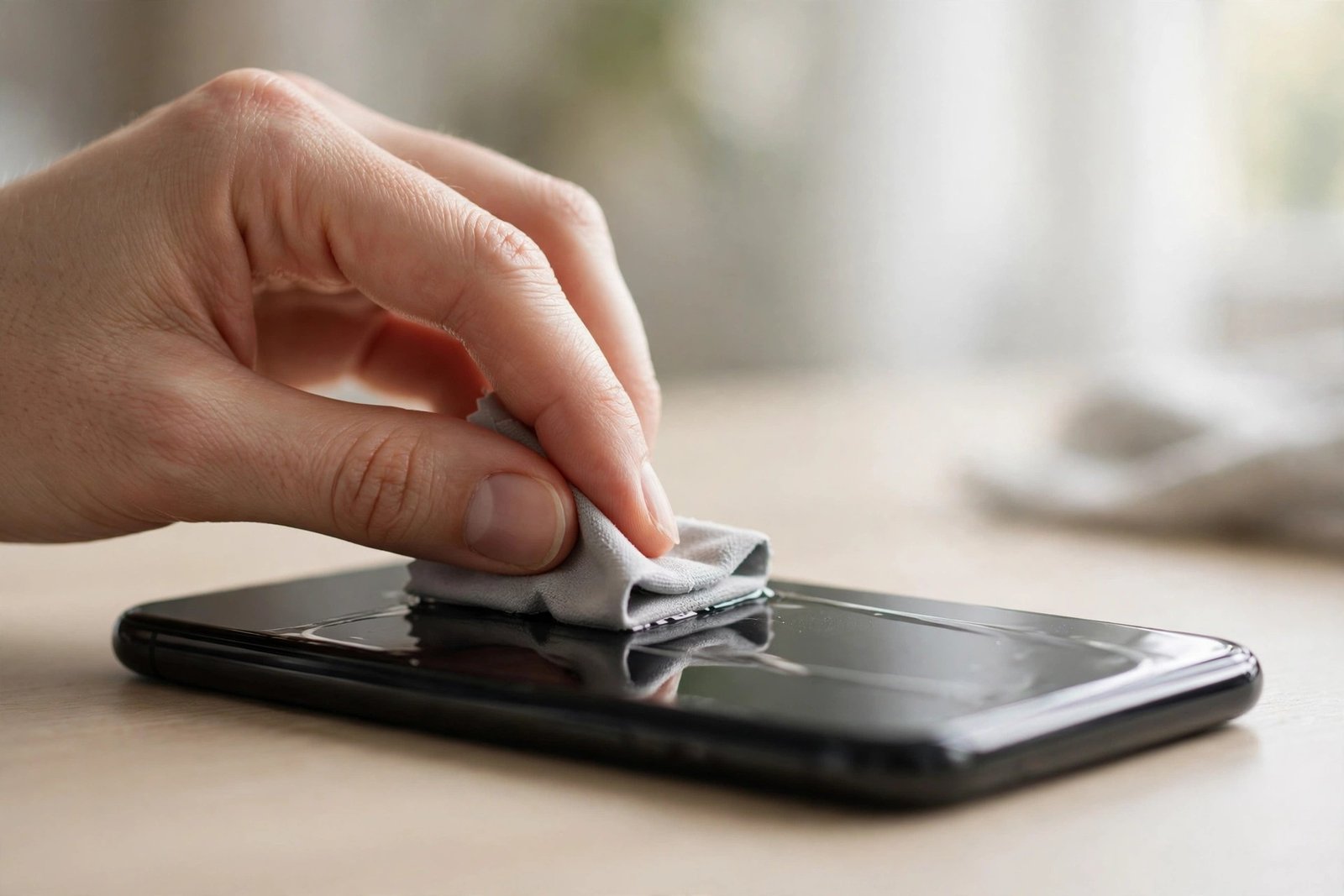
When you wipe the liquid across a clean screen, the solution flows over the glass. Phone glass looks perfectly smooth to the eye, but at a microscopic level it is covered in tiny pores, ridges and imperfections. The liquid pools in those low spots first, which is exactly where you want the material to end up.
Next, the solvent evaporates. As it disappears, the silicon dioxide is left behind in a continuous, ultra-thin film that follows the contours of the glass and bonds to its surface. This is why application instructions always stress starting with a spotless screen: anything trapped underneath — grease, dust, fingerprint oil — gets sealed in and weakens the bond in that spot.
Finally, the coating cures. Over the following hours the film hardens into its finished state. Exact curing times vary by product, so follow the instructions supplied with yours rather than assuming a fixed number. During curing, the newly levelled surface is at its most vulnerable, which is why most kits advise keeping the phone away from pockets, water and rough handling until the coating has set.
- Think of a liquid protector as filling in the pores of the glass rather than armouring it. That mental picture predicts everything about how it behaves: great against fine surface wear, useless against a dropped phone.
Why It Helps Fine Scratches — and Not Drops
Many everyday scratches are extremely shallow: grit in a pocket, a grain of sand on a cloth, the edge of a key. By filling the microscopic texture of the glass with a hardened mineral layer, the coating presents a smoother, slightly harder surface to those small abrasives, so the shallowest scratches are less likely to bite into the glass itself. The smoother surface also tends to feel slicker and can make fingerprints wipe away a little more easily.
Impact is a different problem entirely. When a phone lands on a corner, the energy involved is enormous compared with anything a film a few nanometres thick can absorb. Tempered glass protects against drops by being a thick, sacrificial layer that can flex minutely and crack in the screen’s place. A nano-coating has no meaningful thickness, no flex, and nothing to sacrifice. Claims that a wipe-on coating makes a screen shatterproof should be treated with scepticism — no coating that thin can change the physics of a fall.
How the Coating Wears Away
A liquid protector is not permanent. Every swipe of your thumb, every trip in and out of a pocket, and every cleaning wipe removes a vanishingly small amount of the coating — and because there is so little of it to begin with, it gradually thins until it is effectively gone. Areas that see the most friction, such as the centre of the screen where you scroll, wear fastest.
This wear is invisible, which cuts both ways: the coating never looks shabby, but you also get no obvious signal that it has worn through. Manufacturers typically describe longevity in months rather than years, and advise periodic reapplication — check the guidance supplied with your product for its stated lifespan. Harsh chemicals, abrasive cleaners and hand sanitisers can strip the layer faster, so gentle cleaning extends its life.
- Because the coating is invisible and wears silently, set a calendar reminder to reapply based on the lifespan stated in the product instructions — otherwise you may go months believing you are protected after the layer has effectively worn away.
Frequently Asked Questions
Can you see or feel a liquid screen protector?
Not really. Once cured, the layer is only nanometres thick, so there is no visible edge, no added bulk and no change to how the screen looks. The surface may feel marginally smoother to swipe across, but most people cannot tell it is there at all — unlike glass or film, there is nothing to peel, lift or align.
Does a liquid protector work with in-display fingerprint sensors?
Generally yes, because the coating adds no meaningful thickness for the sensor to read through — this is one of its genuine advantages over some thick glass protectors. That said, sensor behaviour varies between phone models, so if your fingerprint unlock becomes unreliable after application, re-registering your fingerprints is a sensible first step.
Can I put a glass protector over a liquid coating?
Usually, yes — the coating is thin enough that a glass protector’s adhesive can still bond over it, and many people use a liquid coating on the exposed back glass while fitting tempered glass on the front. If adhesion looks patchy, the surface may need a thorough clean first. Follow any guidance supplied with both products, as combinations are rarely tested by manufacturers.
A liquid protector is surface science, not armour: it levels and hardens the top few nanometres of your glass against everyday wear, and quietly wears away doing it. Treat it as a renewable coating with honest limits, and it will do its small job well.