Every year, millions of people peel a thin sheet of glass out of a packet, stick it to a brand-new phone, and trust it to stand between their screen and disaster. But does a tempered glass screen protector actually work — or is it just expensive peace of mind? The honest answer is that it works very well at some things, moderately at others, and not at all at a few things people commonly assume.
A tempered glass protector is a sacrificial layer. It is designed to take damage so your real screen doesn’t have to. Judged on those terms — scratches avoided, moderate drops survived, a cheap sheet replaced instead of an expensive display — it earns its place. Judged as armour that makes a phone indestructible, it will always disappoint.
Key Takeaways
- Tempered glass is excellent against scratches — keys, coins and pocket grit mark the protector, not your screen.
- In a moderate drop, the protector often cracks so your screen doesn’t have to — that is it working, not failing.
- It has real limits: corner-first falls onto concrete concentrate force in a way no thin sheet of glass can fully absorb.
- Viral drop tests are entertainment, not evidence — drop height, angle and surface matter more than the brand.
- A cracked protector has done its job once and should be replaced; it cannot absorb a second impact the same way.
How Tempered Glass Actually Protects
Tempering is a heat treatment that puts the outer surfaces of the glass into compression. That makes the sheet harder to scratch and, crucially, changes how it breaks: instead of shattering into sharp shards, it fractures into a web of small, relatively blunt pieces and — on a protector — usually stays in one piece thanks to the adhesive layer beneath it.
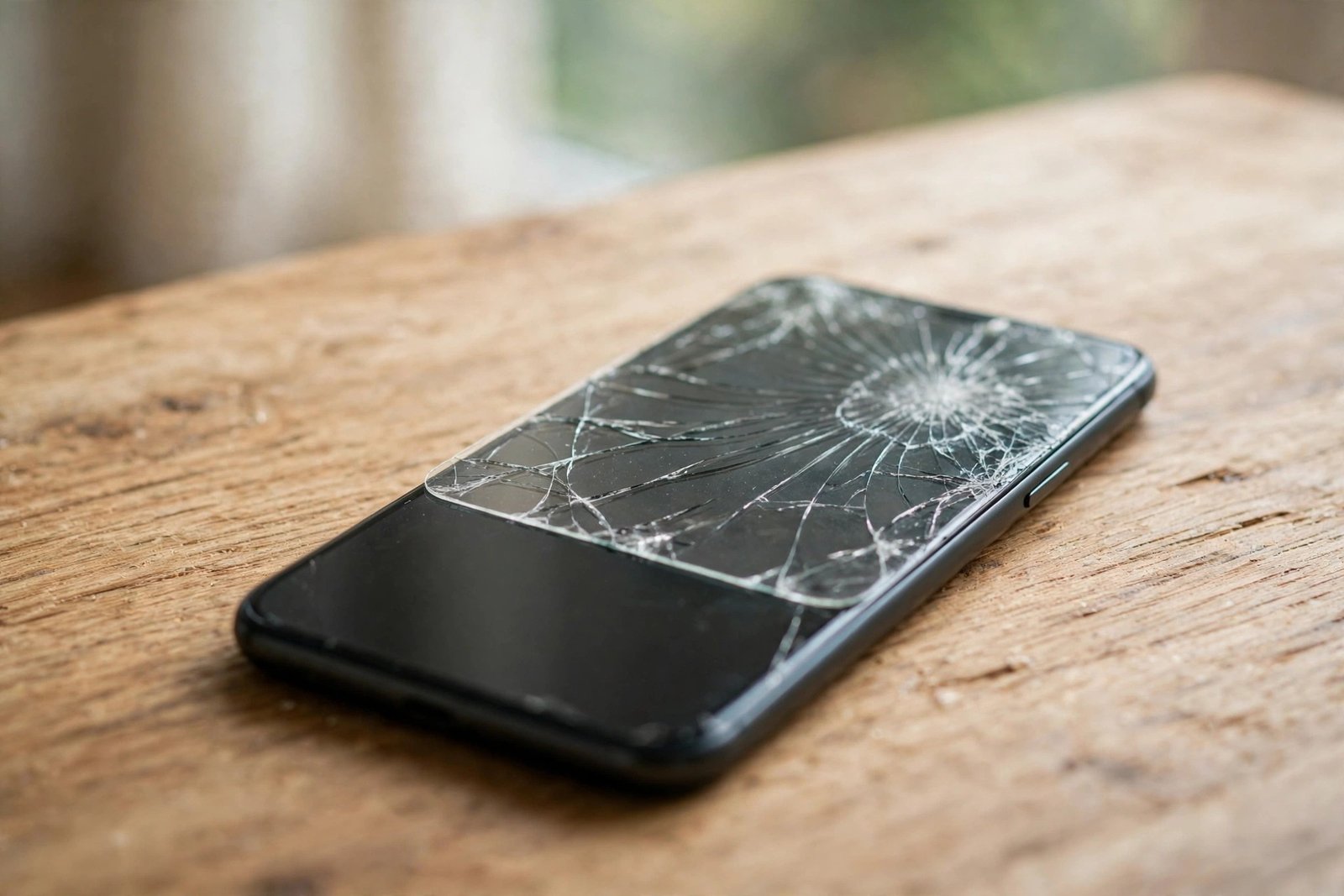
When your phone falls face-down, the protector is the first thing to meet the ground. The impact energy has to go somewhere, and a well-fitted sheet of tempered glass spreads that energy across its surface and absorbs some of it by cracking. Every crack in the protector is energy that did not reach the display underneath. This is why a smashed protector over an intact screen is the classic success story — the cheap layer spent itself so the expensive one didn’t.
Against scratches, the case is even clearer. Everyday abrasives — sand, grit, keys, coins, the rivets on jeans — are what actually mark most screens over time. A protector intercepts all of it. When it eventually looks tired and scuffed, you peel it off to reveal a screen that still looks new, and fit a fresh one.
Where Tempered Glass Falls Short
The protector’s weakness is geometry. A phone that lands corner-first concentrates the entire impact into a tiny point, and the force travels through the frame and into the display from the side — a direction the surface sheet can do little about. Falls onto rough concrete, gravel or a protruding stone can also punch through any protector, because the impact is focused on one small spot rather than spread out.
Fit matters too. A protector that is too small leaves the curved edges of modern screens exposed, and those edges are often where cracks start. A protector with an air gap in the middle — usually a sign of poor adhesive or a slightly warped sheet — cannot spread impact properly and may also dull touch response. And no protector helps at all if the phone lands on its back or the impact bends the frame.
- Pair the protector with a case that has a raised lip — the lip guards against corner-first falls, which is exactly the scenario glass handles worst. The two protect in different ways and complement each other.
- Check the edges after fitting: full, even adhesion with no lifting corners is what lets the sheet spread impact across its whole surface.
What Drop Tests Can and Cannot Prove
Drop-test videos are compelling viewing, but treat them as demonstrations, not data. A single drop tells you what happened once, on one surface, at one angle, from one height. Change any of those variables and the result can flip. The same phone with the same protector might survive ten drops onto smooth tiles and break on the first drop onto gravel, because a single raised stone focuses the force.
There is also no standardised test the way there is for, say, water resistance ratings. Manufacturers’ own claims are made under conditions they choose. Hardness ratings are widely misunderstood too: the commonly quoted “9H” figure comes from a pencil hardness scale used for scratch resistance — it says something about resisting scratches and nothing meaningful about surviving drops.
What the collective evidence — years of repair-shop experience and owner reports — does support is a modest, believable claim: tempered glass meaningfully improves your odds in everyday falls from pocket or hand height onto reasonably flat surfaces, and it is close to total protection against scratches. That is a genuinely useful benefit. It is just not a guarantee.
- When a protector cracks, replace it rather than living with it. The fracture web has already spent the sheet’s ability to absorb impact, and loose edges can trap grit against the real screen.
- Keep the spare from a multi-pack in the same drawer as your phone charger — a cracked protector left on for weeks protects far less than a fresh one fitted the same day.
Frequently Asked Questions
If my protector cracked but my screen is fine, did it work?
Almost certainly, yes. The protector absorbed and spread impact energy by fracturing — that is precisely its job. It is impossible to prove the screen would have broken without it, but a cracked protector over an unmarked display is the outcome the design intends. Fit a replacement, because the cracked sheet cannot do the same job twice.
Does a thicker protector protect better?
Only marginally, and with trade-offs. Very thick glass can feel bulky, interfere with some cases and sit proud of curved edges, which creates new weak points. For most people, a standard tempered glass protector that fits well and adheres fully protects better in practice than a thicker one that fits poorly.
Will a protector stop my screen cracking in any drop?
No — and any product implying that should be treated with suspicion. Corner-first impacts, rough surfaces and greater heights can defeat any protector. Think of it as shifting the odds strongly in your favour for the common, everyday drops, not as insurance against every possible fall.
Tempered glass works — as a sacrificial layer, not a suit of armour. Fit it well, replace it when it cracks, and let it take the damage your screen was never meant to.