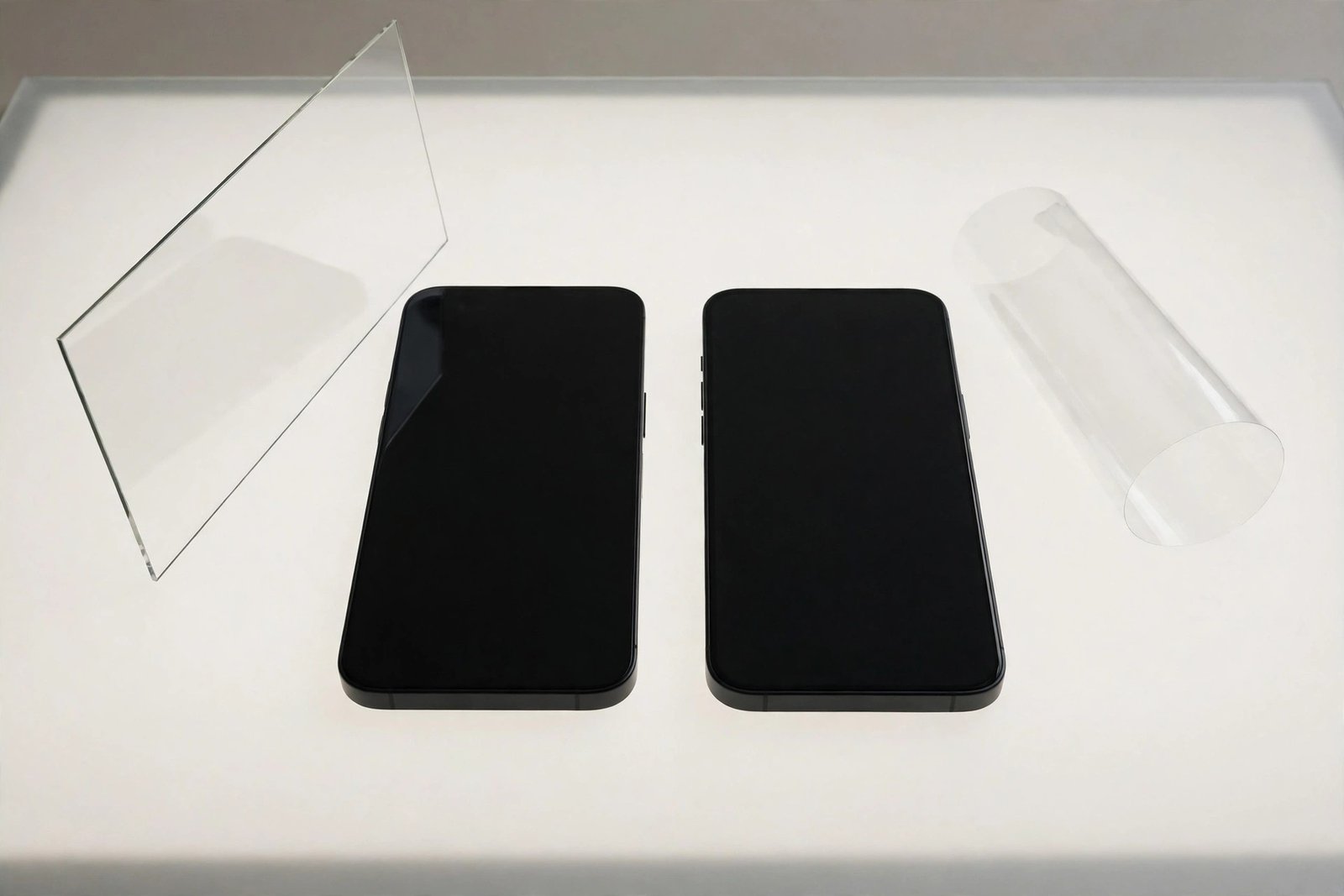
Every screen protector falls into one of two families: tempered glass, a thin pane of hardened glass, or film, a flexible sheet of plastic. Glass has become the default recommendation in recent years, but that does not automatically make it the better choice for you — the two materials behave very differently in your hand, on curved screens, and at the moment of impact.
This guide compares them fairly, category by category — touch feel, clarity, protection, fit and thickness — so you can decide which type suits your phone and the way you actually use it, rather than simply buying whichever one shouts loudest.
Key Takeaways
- Tempered glass feels closest to the bare screen — smooth, cool and slick under your fingertip.
- Glass resists everyday scratches from keys and grit far better than plastic film.
- Film is thinner and more flexible, so it hugs curved screen edges that glass cannot follow.
- Against a hard drop, glass sacrifices itself by cracking; film survives but offers less absorption.
- Neither is “best” overall — the right answer depends on your screen shape, habits and budget.
Touch Feel and Clarity
This is glass’s home ground. A tempered glass protector is, literally, glass — so your finger meets the same smooth, cool, low-friction surface as the screen itself, usually finished with an oleophobic coating that resists fingerprints. Taps and swipes feel unmediated, and because the material is optically clear and rigid, it adds virtually no distortion or haze to the display beneath.
Film feels different, and you will notice it. Plastic has more drag under a fingertip — a faintly rubbery resistance — and cheaper films can develop a slight orange-peel texture that shows in reflections. That said, film has an optical trick glass cannot match: matte film deliberately diffuses reflections, cutting glare in bright rooms and daylight. If you mainly use your phone outdoors, that trade — a little sharpness for a lot less glare — may matter more to you than slickness.
Protection: Impacts and Scratches
For scratches, glass wins decisively. Its hardened surface shrugs off the everyday enemies — keys, coins, and the grit that collects in pockets and bags — which score visible lines into plastic film within weeks. A film protector will still prevent that grit from reaching your actual screen, but it will look worn quickly while doing so.
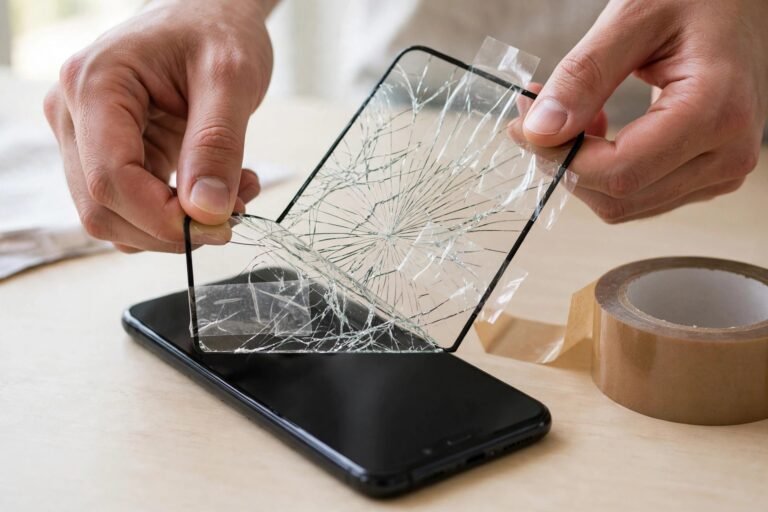
Impacts are more nuanced. Tempered glass is rigid, so when a drop concentrates force on it, the pane cracks and absorbs energy that might otherwise reach the screen — a deliberate sacrifice. Film cannot absorb force that way; it flexes and passes more of the blow through, though it does spread the load slightly and protects against the glancing, scraping impacts of a sliding fall. In short: glass defends better against the drops it can survive by dying, film defends better against scrapes and survives more incidents without needing replacement.
- Ignore the “9H hardness” arms race in listings — it refers to a pencil hardness scale and tells you little about real-world drop protection.
- Whichever material you choose, edge coverage matters as much as material: a protector that leaves the screen’s curved rim exposed leaves its weakest point unguarded.
Fit, Thickness and Curved Screens
Here the contest flips. Glass is typically around 0.3mm thick and completely rigid, so on phones with strongly curved display edges it either stops short of the curve — leaving a visible border and a lip your thumb catches on every swipe — or it relies on adhesive only around its rim, which can reduce touch sensitivity in the middle. It also adds a perceptible step at the edge of the screen.
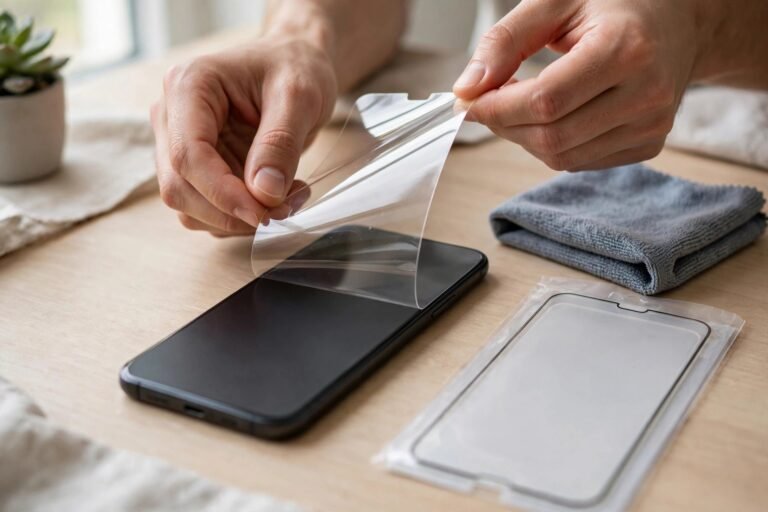
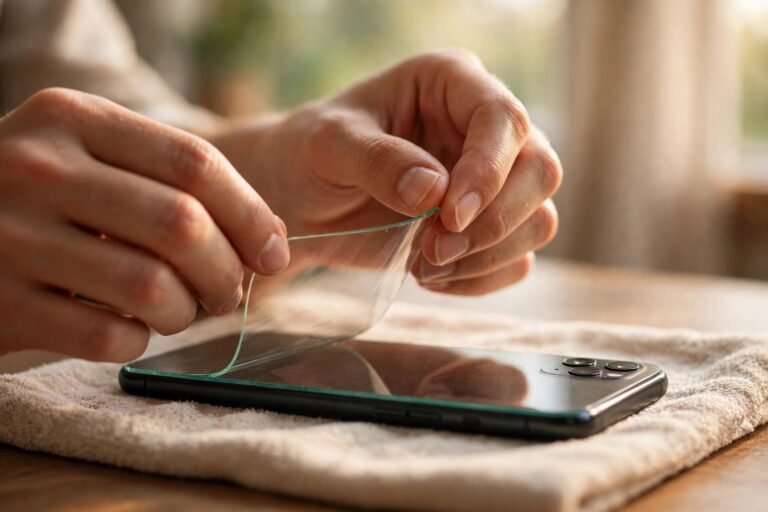
Film is a fraction of that thickness and bends willingly, wrapping fully over curved edges and disappearing from view and touch. It is the natural partner for curved displays, folding phones, and anyone who finds the edge of a glass pane annoying. Film is harder to install without bubbles, though modern wet-apply and self-healing films have narrowed that gap considerably.
So Which One Suits You?
Choose tempered glass if your screen is flat or gently curved, you want the protector to feel invisible, you keep your phone loose in a pocket or bag with keys, and you are happy to replace a cracked pane occasionally — that cracking is the protection working. Most people, most of the time, land here.
Choose film if your display curves sharply at the edges, you use a folding phone, you prefer the absolute thinnest profile, or you want a matte anti-glare finish. Film also suits careful users whose main enemy is micro-scratches rather than drops. And there is no rule against changing camps: many owners run glass on flat phones and film on curved ones, matching the material to the screen in front of them.
- If your phone has an in-display fingerprint reader, film’s thinness can make unlocking snappier; re-register your fingerprints after fitting either type.
- Hybrid protectors — a flexible material with a glass-like coating — exist for curved screens, but judge them by the film column of this comparison, not the glass one.
Frequently Asked Questions
Does tempered glass feel exactly like the bare screen?
Very close. The surface is real glass with a similar fingerprint-resistant coating, so glide and clarity are nearly indistinguishable in use. The only giveaway is the slight raised edge your thumb meets when swiping in from the border of the screen.
Are film protectors better for curved screens?
Generally, yes. Film flexes to follow the curve and adheres across its whole surface, avoiding the lifted borders and dusty edges that plague rigid glass on strongly curved displays. If your screen’s edges curve only gently, glass made for your model can still fit well — check that it is described as case-friendly and fully adhesive.
Which type lasts longer before it needs replacing?
It depends on what your phone endures. Film rarely breaks but accumulates scratches and cloudiness, so many owners replace it every few months for looks. Glass keeps its clarity until the day it cracks — which may be one bad drop or may be years away. In practice, gentle users get longer from glass; heavy users who drop phones monthly sometimes spend less on film.
Glass wins on feel and scratch defence; film wins on curves and subtlety. Match the material to your screen’s shape and your own habits, and either one is the right answer.