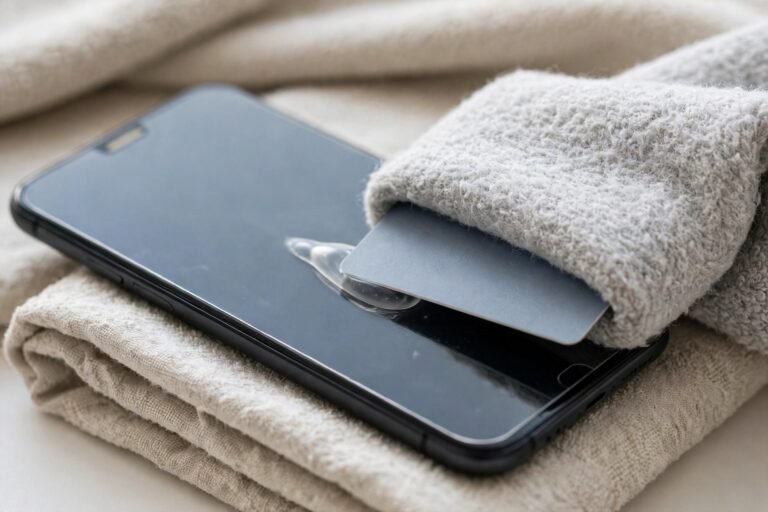
One bubble. The install went well, the edges are perfect, and there it sits — a single round bubble that catches the light every time you unlock your phone. The temptation is to press on it, rub at it, maybe lift the whole pane and start again. Resist all three. A single bubble almost always has a single, identifiable cause, and each cause has exactly one correct fix. Diagnose first, and the repair takes a minute.
There are only two real suspects: trapped air, and a speck of dust holding the glass up like a tent pole. This guide shows you how to tell them apart in ten seconds, then walks through the precise fix for each — and what it means when the same bubble keeps coming back.
Key Takeaways
- Look before you press. A bubble with a speck visible at its centre is dust; a clear, glassy bubble with nothing inside is air.
- The fingertip test separates them: press beside the bubble — an air bubble shifts or flattens, a dust bubble stays put around its speck.
- Air bubbles are fixed from the outside, with pressure worked towards the nearest edge. Never lift the pane for air alone.
- Dust bubbles need a tape lift and a sticker, raising only the nearest corner and only for a few seconds.
- Work on a bubble the day you spot it — fresh adhesive forgives; week-old adhesive holds the bubble’s shape.
- A bubble that returns to the exact same spot is telling you something: contamination, a deformed pane, or case pressure at that point.
The Ten-Second Diagnosis
Turn the screen off and hold the phone under a bright lamp, tilting it slowly. Look into the bubble, not at it. If it’s a dust bubble, you’ll see the culprit as a tiny dot or hair at the very centre, with the glass tented up around it and often a faint rainbow halo where the glass curves away. An air bubble, by contrast, is empty — a smooth, lens-like pocket with clean edges that change shape as the light moves.
Confirm it with a fingertip. Press gently on the glass just beside the bubble and slide your finger a few millimetres. Trapped air moves with the pressure — the bubble flattens, bulges sideways, or creeps towards the edge. A dust bubble barely reacts; the speck pins it. That ten seconds of diagnosis decides everything that follows, because the two fixes are opposites: one never lifts the glass, the other must.
- Diagnose with the screen off. A lit display hides specks completely; against black glass, a dust grain shows up white and obvious.
- Mark the bubble’s position with a fingertip before you start — small bubbles have a habit of vanishing under working light and reappearing in daylight.
Fixing a Pure-Air Bubble
For air, the tool is pressure with a destination. Decide which edge is nearest the bubble — that’s where the air is going. Using your thumb wrapped in a microfibre cloth, or the edge of a card under a cloth, start on the far side of the bubble and push in one slow, firm stroke towards that edge, keeping the bubble ahead of your stroke like a bead of water being herded off the glass. Two or three strokes, each a little slower, usually walk it out completely.
If the bubble reaches the edge but seems to stop at the border, the perimeter adhesive has sealed it in. Hold firm pressure right at the edge for twenty seconds to persuade the seal to release. If it still won’t shift, warm the area with a few minutes of ordinary phone use — warm adhesive is softer and lets trapped air migrate through it overnight, which is why some edge bubbles vanish by morning after a good press.
Fixing a Dust Bubble
Dust requires a brief, surgical lift — of one corner only, never the whole pane. Stick a piece of tape to the protector’s surface at the corner nearest the bubble and raise the glass just enough to slip the dust-removal sticker underneath. Dab the sticker at the speck — check both the underside of the glass and the screen, because the grain may be stuck to either — then lower the pane slowly, pressing from the lifted corner outward so you don’t trap a fresh pocket of air on the way down.
Speed and cleanliness decide whether this works. Do it in steamy bathroom air if you can, keep the lift under a centimetre at its highest, and have the sticker already in your other hand before the glass moves. Every extra second the corner is raised invites two new specks to replace the one you removed. Done briskly, the whole repair takes under thirty seconds.
- No dust sticker left? A fresh piece of ordinary sticky tape, pressed lightly, works as a substitute — lightly, or it leaves residue of its own.
- If the speck is stuck to the protector’s underside, dab that surface; if it’s on the screen, dab the screen. Guessing wrong doubles your lifts.
When the Bubble Keeps Coming Back
A bubble that returns to the identical spot within a day is diagnostic gold. If it’s air, something is lifting the glass at that point — most often a case lip pressing unevenly, or a pane very slightly deformed during fitting. If it’s dust-shaped but no speck can be found, the “speck” may be a tiny pit or raised flaw in the protector’s adhesive itself. Either way, repeated pressing won’t cure it. Try a day without the case to test the first theory; if it persists, the honest fix is a fresh pane fitted after a meticulous clean — some bubbles are the protector, not the technique.
Frequently Asked Questions
Can I fix a bubble that appeared a week after fitting?
Often, yes — especially an air bubble. The adhesive has firmed up, so work more slowly and warm the phone first with normal use; the bubble will move reluctantly, but it will usually move. A dust bubble can also still be lifted and cleaned after a week, though the raised corner may leave a faint edge mark that takes a day to settle back down.
Should I pop the bubble with a needle?
No. A needle punctures film protectors and simply chips tempered glass, and either way it solves nothing: the air was never the problem in itself — the gap between glass and screen is. A puncture adds a permanent defect, lets moisture and dirt in, and on glass creates a stress point that a crack can start from. Pressure or a tape lift, never a pin.
Why does my bubble have a halo ring that won’t flatten?
The halo is the zone where the glass is bent up around a central point — almost always a dust speck or fibre at the middle, holding the pane off the screen. Pressure can’t flatten it, because you’d be asking the glass to bend through the speck. The fix is the dust fix: a small tape lift, a sticker dab at the centre point, and a careful lower.
One bubble, one cause, one fix. Ten seconds of looking saves ten minutes of pressing — and the pane stays on the phone, where it belongs.