Film protectors trap bubbles differently from glass, and they have to be cleared differently too. A glass pane is rigid enough to bridge over a pocket of air; a thin film sheet drapes and flexes, so a bubble under film is not a sealed pocket so much as a place where the sheet has not yet made full contact with the screen. That is genuinely good news: bubbles under film can still be moved — provided you move them the film way, with rolling pushes from the centre, not the hard pokes and jabs people use on glass.
This guide covers film protectors only — flexible PET and TPU sheets — including the edges that keep lifting no matter how often you press them down. If your protector is rigid tempered glass, its bubbles behave differently and need a different technique; everything below is the film method, start to finish.
Key Takeaways
- Film bubbles are movable — the sheet flexes, so air can be rolled out to the edge instead of staying trapped.
- Always work from the centre outward. Pushing towards the middle only drives air deeper under the sheet.
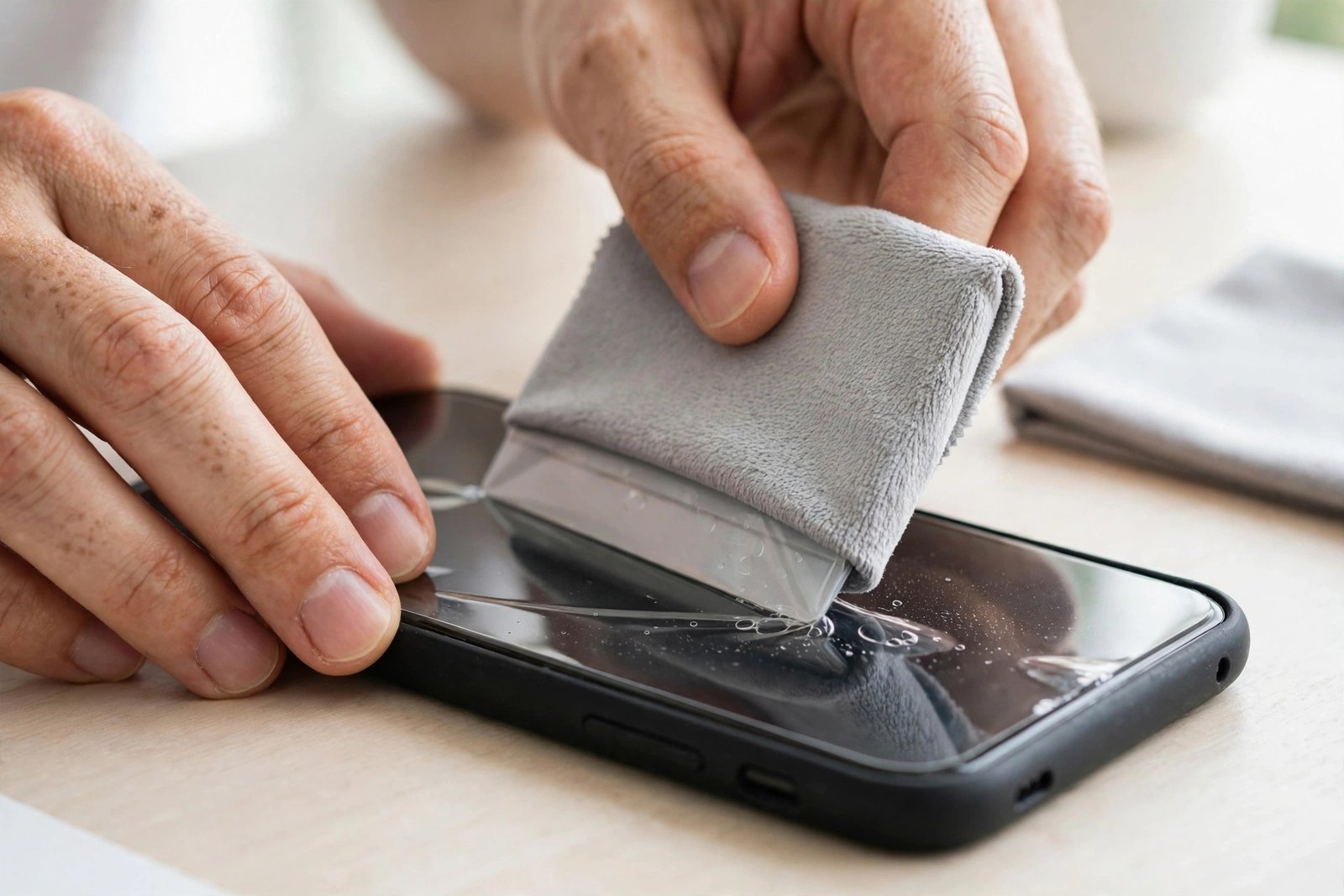
- Use a card wrapped in a microfibre cloth and roll the push over the bubble — a bare card edge can crease film.
- An edge that keeps lifting usually has dust or a crease at the border. Clean and reseal it; pressing alone will not hold.
- Warm film is more cooperative — the heat of normal phone use keeps it supple and helps late bubbles migrate out over days.
- A bubble with a speck at its centre is dust. Rolling will never fix it — that one needs a lift and a clean.
Why Film Traps Air Differently
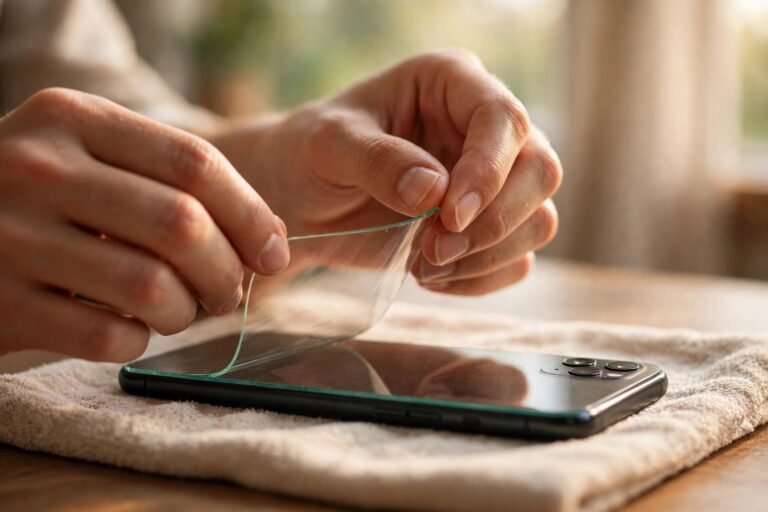
Film goes on progressively — anchored at one edge and rolled or laid down in stages — so any hesitation or unevenness folds air underneath as it lands. Because the material is thin and conforming, it also wraps itself around specks and fibres that glass would barely notice, tenting up into small ringed bubbles. The trade-off for this fussiness is flexibility: film’s adhesive never sets as completely as glass adhesive does, which means its bubbles stay mobile for days rather than hours. You have more time to fix them, with a technique that works because the sheet can flex.
The Rolling Push: The Only Stroke That Works on Film
Wrap a plastic card in your microfibre cloth — the cloth softens the card’s edge so it cannot crease the film. Place the wrapped card near the centre of the screen and make a slow, firm stroke outwards, keeping steady pressure as you go, so the bubble travels ahead of the card and out at the edge. Overlap your strokes and work through them methodically, centre to edge, section by section. If a bubble splits in two, chase the larger half first; the smaller one often follows it out on the next pass.
Two mistakes ruin the technique. The first is jabbing — poking at a bubble with the card’s corner dimples the film and divides the air into smaller, harder bubbles. The second is pushing in the wrong direction: a stroke that ends in the middle of the screen has simply moved the air somewhere worse. Every stroke should start inward of the bubble and finish beyond it, at the nearest edge. Finish with one firm pass around all four borders to seat them.
- Use the phone for ten minutes first, or warm your hands — supple, slightly warm film releases air far more readily than cold, stiff film.
- If a bubble keeps reforming in the exact same spot, stop pushing: something underneath is causing it, almost always a speck or a hair the film is tenting over.
Resealing Edges That Keep Lifting
An edge bubble that returns within minutes of being pressed down is rarely about air at all. The usual causes are dust settled along the border, a slight crease in the film at that edge, or a case lip pressing on the film and levering it up. The timing tells you which: an edge that lifts again immediately, phone out of its case, points to dust or a crease; an edge that only lifts once the case goes back on is being lifted by the case.
For dust or a crease, lift that edge of the film slowly — film permits this, provided you keep it low so it does not stretch — and dab the screen edge and the film’s sticky side with a dust-removal sticker. Then roll the edge back down from the centre outward with the wrapped card and hold it under firm pressure for thirty seconds. For a case-caused lift, no amount of resealing will win against the case: the honest fixes are a case-friendly film cut slightly smaller, or a case with a lower lip. As a short-term help, warm the edge with your palm and hold it down — heat makes film conform a little better.
When a Bubble Is Actually Dust
Tilt the phone under a bright light with the screen off and look at any bubble that refuses to move. If there is a tiny dot at its centre — sometimes with faint rings around it, like a crater — the bubble is a tent over a particle, and rolling pushes will slide uselessly over it forever. Lift the nearest edge of the film slowly, keeping it low and flat so the sheet does not stretch out of shape, dab the speck off the screen (or off the film’s sticky face) with a dust-removal sticker, and roll that section back down with the wrapped card, centre to edge, exactly as before.
- Photograph the screen on day one and compare over the next few days — film bubbles migrate so slowly that your eyes alone will miss the shrinkage.
- Judge a film fitting after several days, not the first hour. Film keeps settling long after glass would have finished, and many day-one bubbles are simply still travelling.
Frequently Asked Questions
How long do bubbles under film take to disappear on their own?
Small, dust-free bubbles commonly migrate out over two to seven days, helped by the warmth of everyday use. Rolling pushes speed the process up considerably. A bubble that is completely unchanged after a week is not still settling — it is dust, a crease, or a lifting edge, and it needs one of the fixes above.
Can I use a hairdryer to help the bubbles out?
It is not worth it: a hairdryer easily overshoots into heat that can distort or warp a film sheet, and the benefit over body warmth is small. Ten minutes of normal phone use warms the film to exactly the right suppleness with none of the risk.
There is a crease line in my film with bubbles along it. Can that be fixed?
A soft fold that has not whitened will often relax flat within a day or two, and its bubbles can be rolled out as usual. A true crease — a sharp, pale line where the film was bent hard — is permanent damage to the sheet; the film will never seal evenly along it, and its bubbles will keep returning. That protector needs replacing, and the crease almost always happened during fitting, which is why the wrapped-card rule matters.
Film bubbles are a rolling problem, not a pressing problem: wrap the card, start at the centre, roll every bubble out to an edge, and reseal lifting borders instead of just flattening them. Work with the film’s flexibility and it clears bubbles glass never could.