Watch a phone shop fit a screen protector and you will notice something: there is no luck involved, and no fumbling either. The counter has everything laid out in reach order, the screen gets cleaned in a fixed sequence, the protector is hinged before it is peeled, and the drop itself takes two seconds. Shops fit dozens a day, so they have turned fitting into a bench routine — and the good news is that the routine transfers completely to a kitchen table.
This guide recreates the shop-counter method at home: set up your bench like a technician, hinge the protector so alignment is decided before anything is sticky, and make the drop a single unhurried movement.
Key Takeaways
- Shops succeed through layout, not talent: every item within reach, in the order it will be used, before anything is opened.
- Hinge before you peel — tape the positioned protector along one edge so alignment is fixed while nothing is sticky.
- Clean in the trade’s order: wet wipe, dry buff, dust sticker — and sticker again in the final second.
- The drop is one movement. A hinged protector needs no mid-air aiming, so there is nothing to get crooked.
- Work in steamed, still air — the home version of the shop’s clean bench is a bathroom after a hot shower.
- Check the result under a bright light at an angle, exactly as a technician hands the phone back to you.
Set Up Your Bench Like a Technician
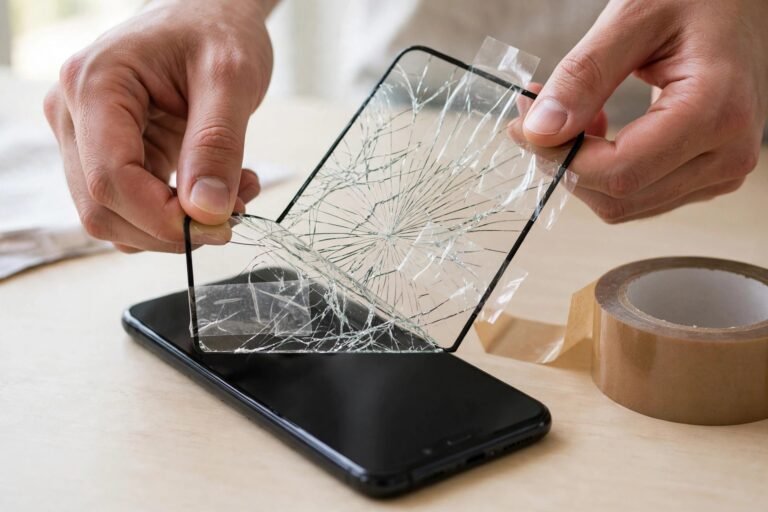
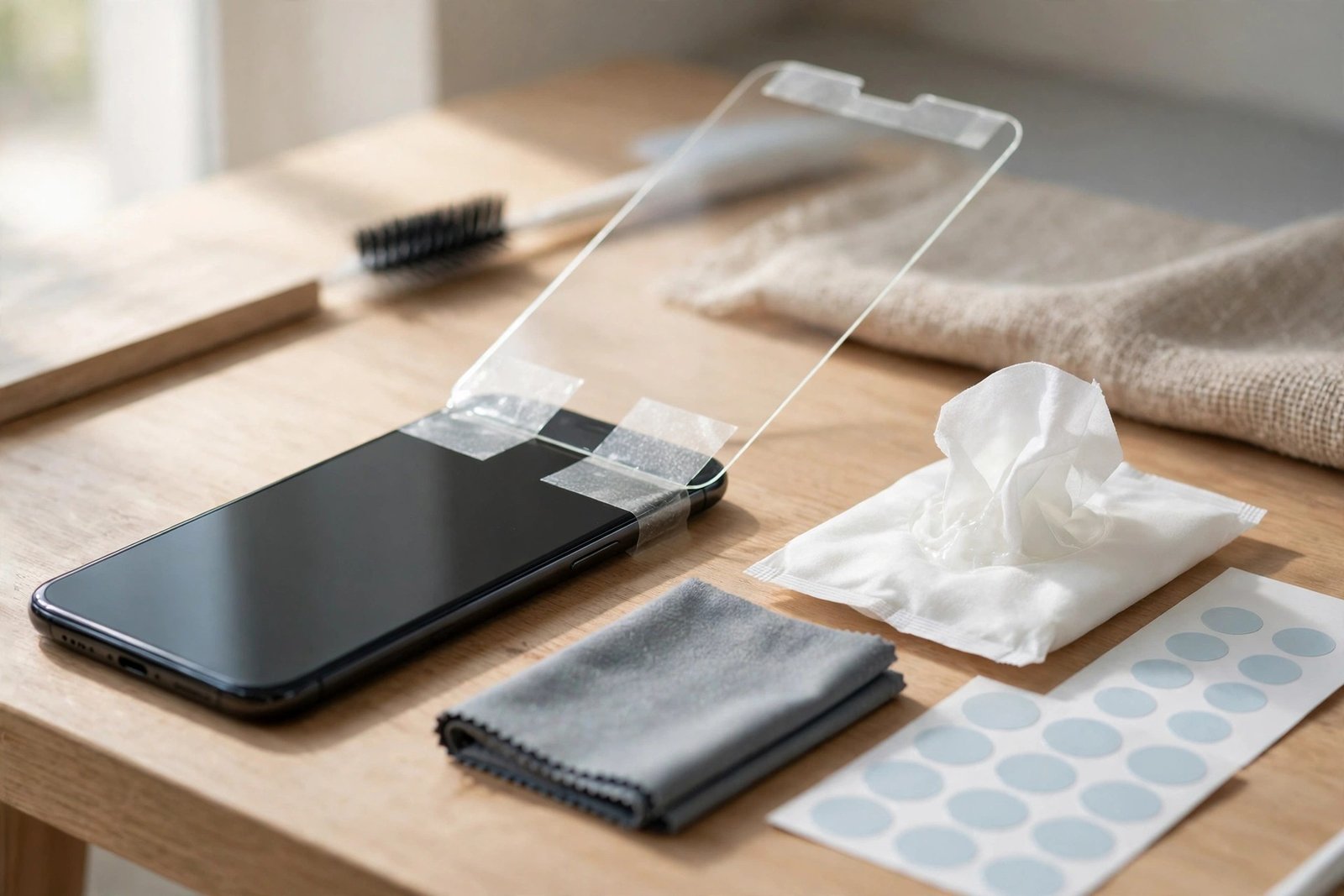
Clear a flat surface and lay out everything in a line, in the order you will reach for it: protector pack, wet wipe, microfibre cloth, dust stickers, tape, and the phone. Shops arrange benches this way because the fitting has a point of no return — the moment the backing comes off — and after it there is no time to hunt through a drawer for a sticker while dust settles on an exposed screen. Wash and dry your hands, take the case off the phone, and remove the old protector if there is one, taping it first if it is cracked glass.
For the air, use the home equivalent of the shop’s controlled bench: run a hot shower for a few minutes and work in the steamy bathroom. Humidity drags airborne dust to the floor — the single biggest quality upgrade a home fitting can borrow from the trade. Lock the phone’s screen before you clean — a dark display shows specks and smears far better than a lit one.
Clean in the Trade’s Order
First, the wet wipe, in overlapping strokes across the whole screen, edges and corners included. Second, buff dry at once with the microfibre cloth — a screen left to air-dry streaks. Third, press the dust-removal sticker over the entire surface and lift it away to collect the invisible specks the cloth missed. Tilt the phone under your light and inspect slowly. Anything you can see gets stickered again. From this point the screen is a no-touch zone, and the clock is running — dust lands on it every second it sits exposed.
- Do the sticker pass twice — once after cleaning, and once more in the very last moment before the drop. Counter staff sticker at the last second for a reason.
- Keep the protector in its pack until the hinge step. A protector waiting exposed on the bench gathers dust just as fast as the screen does.
Hinge It Before You Peel Anything
This is the heart of the shop method. Place the protector on the cleaned screen with its backing still on and nudge it into its perfect position: speaker slot centred, camera cutout clear, margins even on every side. Take as long as you like — nothing is sticky yet. Then stick two strips of tape along one long edge, half on the protector and half wrapped around the back of the phone. The protector is now hinged like a book cover: it swings open for the peel and shut for the drop, returning to exactly the position you set, every time.
If your kit includes an alignment frame, use it instead — it does the same job by clipping over the phone and registering the glass in the only position it can occupy. Frame or hinge, the principle is identical and it is the whole secret: alignment is a preparation step, not a mid-air skill. Technicians do not have steadier hands than you; they have removed the need for them.
The Drop: One Movement
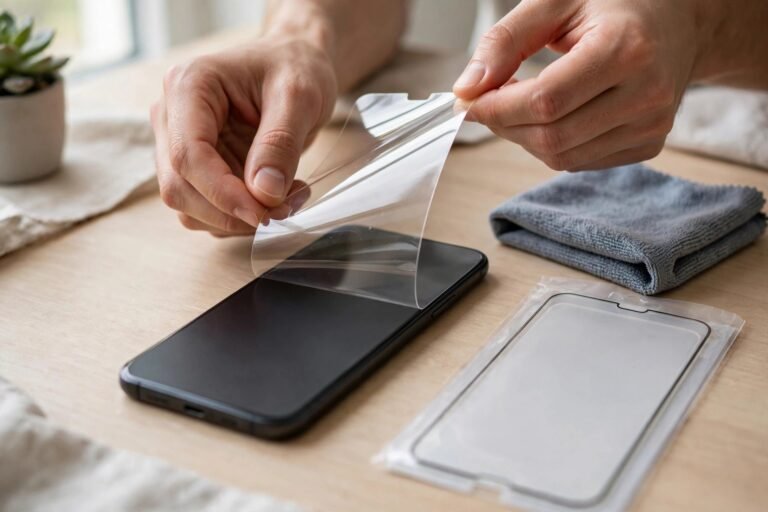
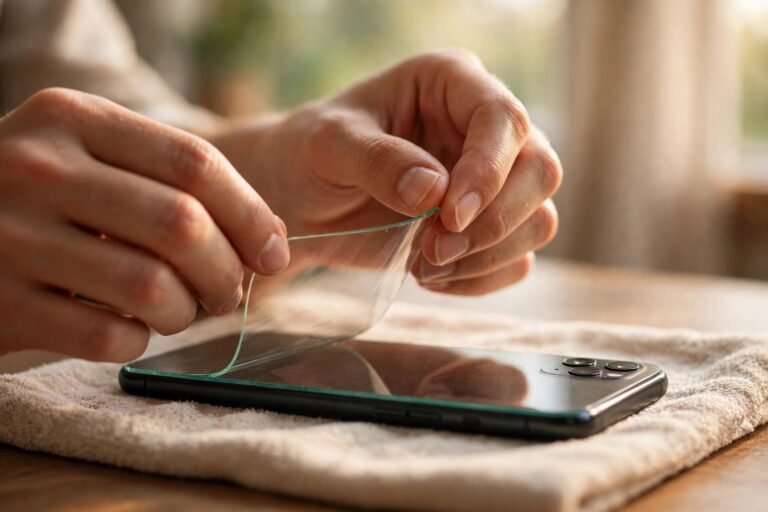
Swing the hinged protector open on its tape, give the screen its final sticker dab, peel the backing away, and close the hinge — lowering the protector into place in one smooth movement, then letting go. Press once, lightly, in the centre and watch the adhesive spread outward as a slow darkening wave. For a film protector, anchor the top edge and roll the sheet down steadily, peeling the backing away as it goes. Resist every urge to nudge, tap, or lift a corner to check: the placement your hinge delivers is the most accurate one available, and corrections are how dust gets in.
- Align by the speaker slot and camera cutout, not the outer edges — a half-millimetre error shows at the cutouts instantly, while the edges hide it.
- Leave the case off for 15–30 minutes after the drop. Shops hand phones back caseless for this window because a tight case fitted too soon shifts fresh glass.
Inspect Like the Counter Does
Run a fingertip firmly around the four edges to seat them, then hold the phone under your bright light at a low angle and turn it slowly — this is the technician’s hand-back check, and raking light exposes every speck and lifting border that flat light hides. Push any plain air bubble to its nearest edge with a slow fingertip stroke. A bubble with a speck at its centre gets the counter fix too: lift the nearest corner on the hinge, dab the speck away with a sticker, close the hinge again. Then stop. Micro-bubbles that remain will settle over the next day or two as the adhesive finishes flowing.
Frequently Asked Questions
What if my protector came with no frame and no hinge stickers?
Use ordinary sticky tape for the hinge, exactly as described above — two strips along one edge. It is the original counter technique from before frames existed, costs nothing, and works with any glass or film protector. Hinge stickers in a kit are simply pre-cut pieces of the same idea.
Why do shop fittings last longer than my home attempts did?
Usually not because of anything done during the drop, but because of everything around it: a screen cleaned in the right order, alignment fixed in advance, and a case left off while the adhesive set. Home fittings typically fail on dust sealed in during a hesitant placement or a case refitted in the first minute. The bench routine removes both causes.
Can I use this routine for a tablet or a second phone straight after?
Yes — the routine is identical, and back-to-back fittings are where it shines, because the bench is already laid out and the air is already steamed. For a tablet, work on a table with the device fully supported and use both hands for the hinge. Clean each screen fresh; never carry a “still clean” assumption from one device to the next.
A professional fitting is a routine wearing a uniform: bench laid out, screen cleaned in order, alignment hinged before the peel, one calm drop. Set your table up the same way and your phone gets the counter treatment — at home, for free.