Tempered glass is the thickest, stiffest protector most people ever fit — typically a third of a millimetre of hardened glass — and its bubbles follow rules of their own. Owners meet the same signature fault again and again: a pale ring clinging to the edges that no amount of thumb pressure will shift. That ring has a name, the halo effect, and understanding it is the difference between fixing your install and fighting it.
This guide concentrates on tempered glass alone: why its thickness changes how bubbles behave, the perimeter-pressing routine that clears most of them, what the halo really is, and how to tell when the pane itself is warped and only a refit will ever sit flat.
Key Takeaways
- The halo effect is a pale edge ring where stiff glass cannot follow the screen’s curve — part physics, not simply trapped air.
- Work the perimeter systematically: firm, held pressure section by section seals most tempered glass edges within two days.
- Thickness means bubbles move slower but stay moved — heavy glass holds a seal once the adhesive takes.
- A halo or bubble on one side only often signals a slightly warped or misaligned pane.
- Never flex tempered glass hard to force an edge down — it is strong in compression, brittle in bending.
- If the ring survives 48 hours of perimeter work, refit with a fresh pane rather than pressing forever.
The Halo Effect, Explained Honestly
Most modern phone screens are not perfectly flat — they curve gently down at the borders. A film protector bends with that curve; a thick tempered pane cannot. Where the screen falls away and the glass stays level, a hair-thin gap remains, and it shows as a whitish outline tracing the rectangle of the pane. That outline is the halo.
Here is the part fitting advice often skips: a mild halo is not always a bubble you failed to remove. If the glass is marginally wider than the flat portion of your display, some ring is geometry, and no technique removes geometry. It can still be reduced — adhesive fills part of the gap as it cures — but judge your result after two days, not two minutes, and judge it by whether it is shrinking.
The Perimeter-Pressing Routine
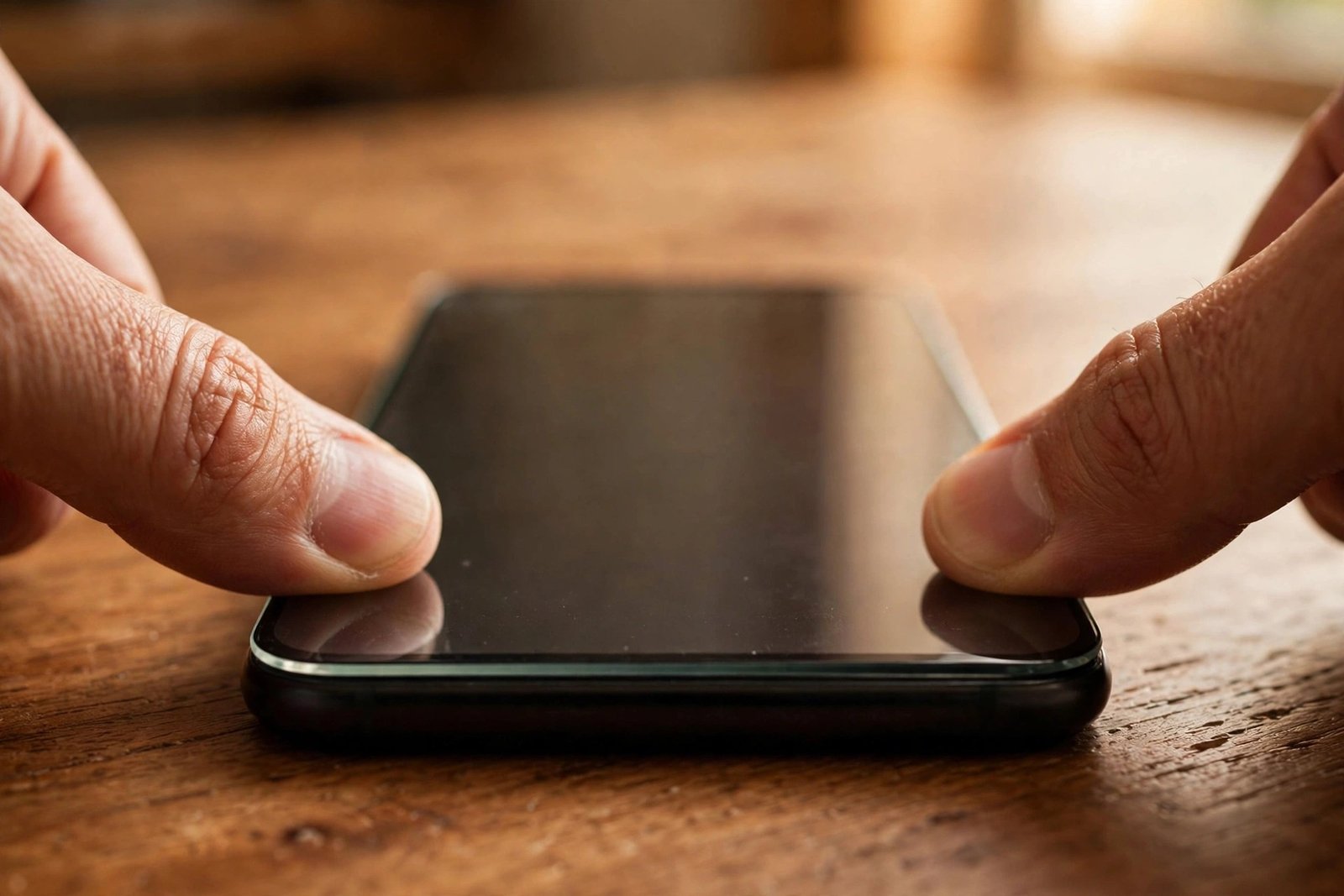
True air pockets under tempered glass respond best to a disciplined routine rather than random rubbing. Start at the centre of the screen and press outward to one edge, then work around the perimeter in short sections — a thumb’s width at a time — pressing each section firmly and holding for ten seconds before moving on. The hold matters: thick glass transmits pressure evenly, and ten held seconds let the adhesive grab while the pocket escapes sideways.
Repeat the circuit morning and evening for two days, ideally somewhere warm. Each pass typically shrinks the ring and the pockets a little further as the adhesive creeps into full contact. Wipe the glass first so you are not pressing grit into the surface, and keep pressure perpendicular — pushing straight down — rather than sliding, which can drag a settled edge back open.
- Do the perimeter routine after the phone has been charging — a gently warmed screen makes tempered adhesive noticeably more cooperative.
- Mark a stubborn section’s outline with a dry-wipe pen dot on top of the glass, so you can see at a glance whether it shrinks between sessions.
Reading a One-Sided Problem
Symmetry is diagnostic. A halo that rings all four edges evenly is the curve of the screen. A halo, bubble, or lifted corner on one side only usually means the pane went on a fraction off-centre — hanging over the curve on one side while sitting short on the other — or that the individual pane is slightly warped, which does happen even in good packs.
Test for warp by symptom rather than sight: if one corner springs back every single time you press it, while the other three hold, that corner of glass is not flat. Within the first hour of fitting you can lift and reposition tempered glass once; after the adhesive has set, a warped pane will never behave, and replacing it is a fix, not a defeat.
- A tight case can push one edge of thick glass upward — remove the case for the first 24 hours while the perimeter seals.
- If you must refit, note which corner misbehaved and start the new pane’s alignment from the opposite side.
Frequently Asked Questions
Is the halo effect a defect in my protector?
Not necessarily. A faint, even halo usually means the pane is slightly wider than the flat area of a curved screen — a sizing mismatch rather than a fault. A strong halo on one side only, or one that grows, points to misalignment or a warped pane, and that is worth a refit or a replacement from the pack.
Can I press harder to speed things up?
Firm is good; force is not. Tempered glass is hardened to resist scratches and impacts from above, but bending stress at an edge can crack it without any warning sound. Held, moderate pressure repeated over two days outperforms one heroic squeeze every time.
Why did bubbles appear days after a clean install?
Usually an edge that never fully sealed. Temperature swings and a snug case flex the phone minutely, an unsealed corner breathes, and air works back under the glass. Run the perimeter routine again with the case off; if the same corner keeps admitting air, that edge is the problem, not your technique.
Tempered glass asks for method, not muscle: understand the halo, press the perimeter with patience, and be honest about the rare pane that was never going to sit flat.