The Apple Watch SE is the watch Apple sells on value — which makes the question of screen protection more pointed, not less. Unlike the premium models, the SE does not have a sapphire crystal front. It uses Ion-X glass, the same reinforced glass found on the aluminium Series models, and while that glass is good at surviving knocks, it is noticeably easier to scratch than sapphire. So: do you need a protector on it? For most owners, yes.
A watch lives a harder life than a phone. It is never in a padded pocket; it rides on your wrist through door frames, desk edges, gym equipment, seatbelts and kitchen worktops, all day, every day. Combine that exposure with softer glass and the economics of repairing a budget watch, and the case for a simple protector becomes strong.
Key Takeaways
- The Apple Watch SE (both generations) uses Ion-X glass, not sapphire — it resists shattering well but scratches far more easily.
- A wrist is a high-impact place: door frames, desks and gym kit mark an uncovered watch face within weeks for many owners.
- Screen repairs on an SE can cost a significant share of the watch’s price, which makes cheap prevention unusually good value (check current repair pricing, as it varies).
- Film protectors are nearly invisible and add no bulk; tempered glass feels better and guards against harder knocks; snap-on covers protect the case too but add size.
- Covers and cases can trap moisture against the watch after swimming or showers — pop them off to dry.
- If your SE is worn gently at a desk and you accept cosmetic wear, going without is a legitimate choice — just make it knowingly.
Ion-X Glass: Tough Against Drops, Softer Against Scratches
Apple uses two very different materials across the Watch range. The stainless steel, titanium and Ultra models get sapphire crystal, which shrugs off almost everything short of diamond. The aluminium models, including every Apple Watch SE, get Ion-X glass instead: a strengthened glass chosen because it is lighter, cheaper, and better at absorbing an impact without shattering.
That trade-off cuts both ways. Ion-X is the more forgiving material when your wrist swings into a door frame, but its surface is far easier to mark. Keys, zips, rough walls, grit on a cloth, even the edge of a laptop can leave fine scratches in Ion-X that sapphire would have ignored. Owners moving from a sapphire model to an SE are often surprised how quickly the face picks up hairline marks. None of them affect how the watch works — but on a small, bright screen you look at a hundred times a day, you will see them.
What Daily Life Does to an Unprotected SE
Think about where your wrist actually goes. It catches the edge of desks and door jambs, scrapes along seatbelt buckles and shopping trolleys, knocks against dumbbells at the gym, and — for anyone with young children — gets grabbed, bashed and dragged across every surface in the house. A phone spends most of its life in a pocket or on a desk; a watch spends its life in the firing line, screen facing outward.
The result, for an uncovered SE, is usually not one dramatic crack but a steady accumulation: a scuff here, a scratch there, a dull patch where the face rubs a gritty sleeve cuff. Add in the repair maths — an out-of-warranty screen replacement on an SE typically costs a substantial fraction of the watch’s purchase price — and a protector costing very little starts to look like the most rational accessory the watch has.
- The single highest-risk moment for a watch screen is reaching into tight spaces — car engine bays, the backs of cupboards, under furniture. If you do DIY, decorating or manual work, a snap-on cover for those hours protects against the one deep scratch a film cannot shrug off.
Your Options: Film, Glass or a Snap-On Cover
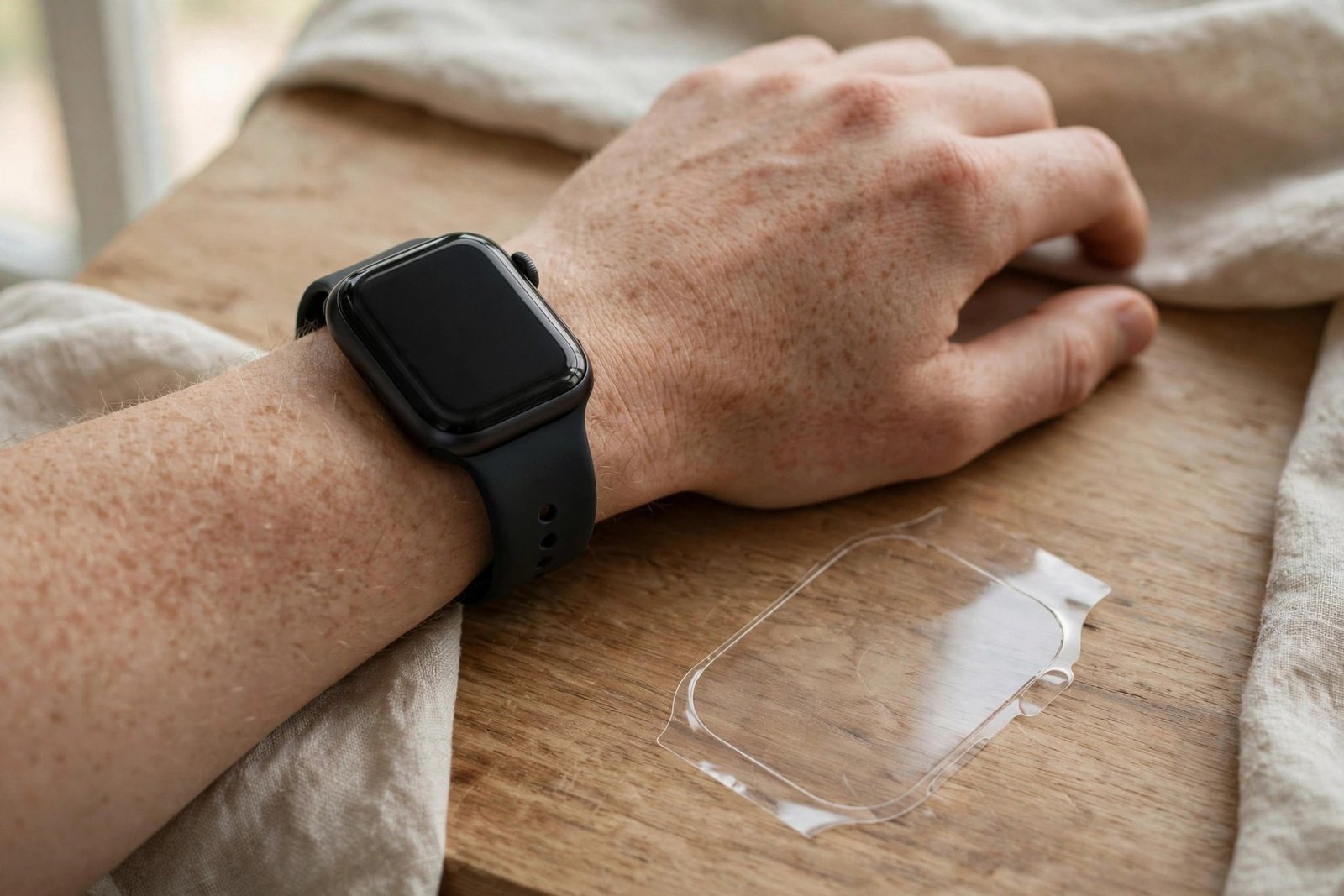
Film protectors are the discreet choice. A thin PET or TPU film is almost invisible once fitted, adds no bulk, keeps touch response exactly as it was, and handles the everyday scuffs that make up most watch wear. Its weakness is impact: film will not save the screen from a hard knock. Tempered glass sits a step up — it feels like the original screen, resists scratches better, and offers some sacrificial protection against knocks, though on a curved watch face the edges can be prone to lifting if the fit is poor.
Snap-on covers — a bumper case with a built-in clear front — protect the case as well as the screen and are popular for sport and manual work. The compromises are bulk, slightly dulled touch, and trapped moisture: water from swimming or showers fogs the cover and can irritate skin if left. Treat a cover as something you fit for activities and remove afterwards to dry, rather than permanent armour. Whichever style you choose, buy the version for your exact case size — both SE generations come in 40 mm and 44 mm.
So, Do You Need One?
For the typical SE owner — someone who wears the watch all day, exercises in it, sleeps in it, and intends to keep it for several years — yes, a protector is worth fitting, and a simple film is enough for most. It preserves the screen you look at constantly, costs very little, and can be replaced in minutes when it has absorbed the damage itself.
The honest exceptions are gentle lives and short ownership. If your SE lives at a desk, comes off for sport and DIY, and you are relaxed about cosmetic marks, Ion-X will serve you fine bare — scratches are an appearance issue, not a functional one. But decide that deliberately: the owners who regret skipping a protector are the ones who assumed the SE’s screen was sapphire like the expensive models. It is not.
- Whichever protector you fit, do it on day one. The curved edges of the watch face pick up micro-scratches early, and a protector fitted over an already-marked screen preserves the marks rather than preventing them.
Frequently Asked Questions
Does a screen protector affect the SE’s touch screen or sensors?
A film or glass protector on the front does not affect the health sensors, which sit on the back of the watch against your wrist. Touch response through a well-fitted film or glass protector is normally indistinguishable from the bare screen. Thick snap-on covers can make swipes feel slightly less precise and may stiffen the side button.
Will a cover or protector affect the watch’s water resistance?
The watch’s own seals are unaffected — the SE is swim-proof to 50 metres with or without a protector. What does happen is that water gets trapped between a snap-on cover and the screen, where it fogs the view and stays against the case. Remove covers after swimming or showering, rinse and dry the watch, and refit the cover dry. Film and glass protectors bonded to the screen do not have this problem.
Does the Apple Watch SE have a sapphire screen?
No. Both generations of the SE use Ion-X glass, the same material as the aluminium Series models. Sapphire crystal is reserved for the stainless steel and titanium Series models and the Apple Watch Ultra. Ion-X is lighter and more shatter-resistant, but it scratches more readily — which is precisely why the SE benefits from a protector more than its pricier relatives do.
The SE gives you Apple’s watch experience at a friendly price — but its glass is the softest in the range, living in the hardest place a screen can live. A simple protector balances that equation for very little money.