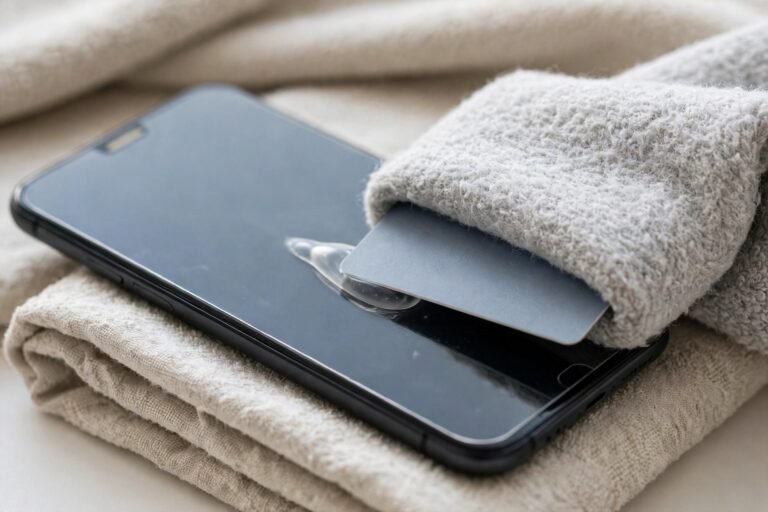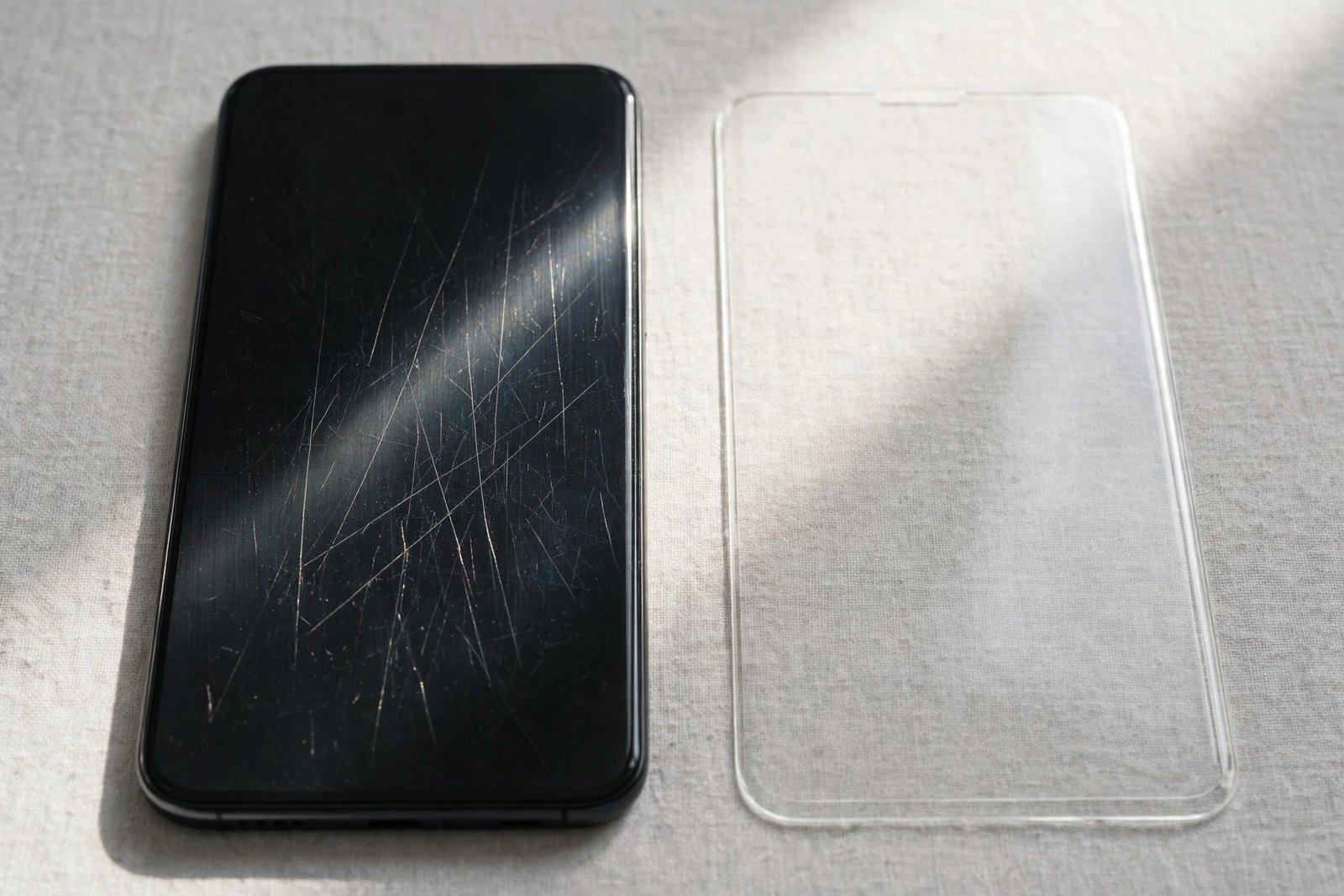
It is a tempting idea: your phone screen has picked up fine scratches, and fitting a screen protector over the top sounds like a way to make them vanish without paying for a repair. There is real physics behind the hope — a protector’s adhesive genuinely can make light scratches far less visible. But it is a cosmetic improvement with clear limits, not a restoration, and deeper damage will show straight through.
This guide explains why some scratches seem to disappear under a protector, which ones never will, and what to watch for when fitting a protector over a screen that is already marked. If you set your expectations by scratch depth rather than by marketing, you are unlikely to be disappointed.
Key Takeaways
- Protector adhesive fills fine scratches, changing how light reflects so hairline marks become much harder to see.
- Only shallow scratches benefit — if you can feel a scratch with a fingernail, a protector will not hide it.
- The effect is optical, not a repair: remove the protector and the scratches are exactly as they were.
- Glass protectors hide slightly more than film because their adhesive layer and rigidity even out reflections better.
- Cleanliness matters twice as much on a scratched screen — grit in a scratch becomes trapped and more visible, not less.
- Cracks are not scratches: a protector can hold a cracked screen together, but it cannot disguise the crack.
Why Adhesive Makes Fine Scratches Fade
You notice a scratch because its rough, angled walls catch light differently from the smooth glass around it. Each scratch acts like a tiny prism, scattering reflections and producing that familiar pale line that shows up most under bright or angled light. When you fit a protector, its soft adhesive layer flows into those microscopic grooves and fills them with a material whose optical properties are much closer to glass. With the groove filled, light passes through far more evenly, the scattered reflection largely disappears, and the scratch fades — sometimes to the point where you have to hunt for it deliberately.
This is the same reason a scratch looks fainter when the screen is wet. The effect is strongest on the finest damage: hairline micro-scratches from keys, grit in pockets, and sliding across desks. These sit within the topmost layer of glass, well within the depth adhesive can fill. Under a good protector, a screen covered in that faint webbing can look surprisingly close to new.
The Honest Limits: Depth Decides Everything
The fingernail test is the most reliable guide. Run a fingernail lightly across the mark. If it glides over without catching, the scratch is shallow and a protector stands a good chance of making it much less visible. If your nail clicks into the groove, the scratch is too deep and too wide for adhesive to fill evenly — air and uneven adhesive remain in the groove, and the line will still be plainly visible under the protector, sometimes taking on a slightly rainbow or shadowed look that draws the eye just as much as before.
Deep scratches also create a fitting problem. A rigid glass protector bridges over a deep groove, leaving a thin air line that looks like a permanent bubble. Film conforms better but fills less. Neither is a fault in the protector — it is the geometry of the damage. No protector can restore coating, polish glass back, or hide chips, cracks, or impact marks.
- Judge your scratches with the screen off under a single bright light at an angle — that is the worst-case view. If marks are only visible in that test, a protector will likely make them invisible in normal use.
- Photograph the screen before fitting. If you later remove the protector, the photo proves the scratches were pre-existing rather than caused by removal.
Fitting a Protector Over a Scratched Screen
Preparation matters more than usual because scratches trap contamination — pocket grit settles into grooves and ordinary wiping skates over the top. Clean thoroughly with the wet wipe in small circles, then dry-buff and use the dust-removal sticker across the whole surface. Any particle left in a scratch gets sealed in by adhesive and can appear as a pinpoint bubble that never settles.
Fit the protector exactly as you would normally, ideally with an alignment frame, and give it the full 24 to 48 hours to cure before judging the result. Fine scratches often look better on day two than in the first hour, because the adhesive continues to flow into the grooves. One caveat for badly scratched screens: adhesion can be marginally weaker overall, since the adhesive is partly busy filling damage, so a tight case fitted immediately is more likely to lift an edge. Wait a little longer before casing the phone than you otherwise would.
Scratches, Cracks, and Liquid Coatings
People often ask about liquid coatings here. A liquid coating works by the same filling principle but with a far thinner layer, so its effect is limited to the faintest micro-scratches and wears away over months. A physical protector fills deeper and lasts until you remove it, which is why tempered glass is generally the more effective option for disguising fine scratches.
Finally, distinguish scratches from cracks honestly. A protector fitted over a cracked screen is a perfectly sensible short-term measure: it holds fragments in place, keeps moisture out, and makes the phone safer to handle. But the crack lines will remain clearly visible through it, touch response over the damaged area may stay unreliable, and the underlying glass will keep weakening. Treat that as first aid while you arrange a screen repair, not as a cosmetic fix.
- If hiding scratches is your main goal, choose a standard clear glass protector — matte and privacy finishes change reflections across the whole screen and can make remaining marks look different rather than less visible.
- Do not use polishing pastes or toothpaste tricks before fitting a protector. They strip coatings unevenly and usually leave the screen looking worse under a protector, not better.
Frequently Asked Questions
Will the scratches come back when I remove the protector?
Yes — they were never gone. The protector only fills the grooves optically while it is fitted. Removing it restores the original air-filled grooves and the scratches look exactly as they did before. Nothing about fitting or removing a protector makes genuine scratches better or worse, provided you clean the screen properly and remove the protector slowly from a corner.
Does a screen protector hide scratches on the protector itself?
No. The filling effect happens between the protector’s adhesive and the phone screen beneath it. Scratches on the exposed top surface of the protector have nothing above them to fill them, so they remain visible — and that is rather the point of a protector: it accumulates the wear so the real screen does not. When the protector itself looks tired, replace it and the screen underneath is revealed in its preserved condition.
Is it worth fitting a protector to an already scratched screen?
Usually, yes. Even setting the cosmetic effect aside, a protector stops existing scratches from worsening, prevents new ones, and preserves resale value from this point on. If most of your marks pass the fingernail test as shallow, you will likely get a worthwhile visual improvement as a bonus. If the damage is deep or the screen is cracked, a protector is still useful as protection and first aid — just do not buy it expecting an invisible repair.
A protector makes fine scratches fade by filling them, not by fixing them — fit one for the protection, enjoy the cosmetic bonus if your scratches are shallow, and expect deep marks to stay honestly visible.